
How to Search Maryland Court Records
The Maryland Judiciary Case Search and Record Portal is the broad first stop for public Circuit Court and District Court summaries, as well as modern appellate matters. It covers civil, criminal, traffic, and publicly displayable family cases across Maryland. Historical depth varies because local systems came online at different times. Anonymous results are selected data, not the official complete court record. The clerk at the location shown in the result remains the source for filed papers, exhibits, recordings, certified copies, archived files, and material available only at a courthouse kiosk.
Start with a full legal name and, when possible, a case or citation number. Add the court system, case type, county, or filing dates to separate namesakes. A blank result can reflect spelling, an older paper file, a restricted case, or a current remote-display rule. It does not prove that no Maryland record exists.
- Open the statewide portal, read the terms and warning, acknowledge them, and continue to the public search.
- Choose a name or case-number search. For traffic, enter the citation as the case number and select Traffic and District Court Only.
- Compare the party, court, case number, filing date, type, and status. Open the matching case detail.
- Write down the exact case number and court location. Use the county directory if the file must be obtained locally.
- Ask the named clerk for the precise pleading, order, recording, or certified disposition needed.
The Judiciary's official Case Search FAQ documents statewide coverage and display limits.
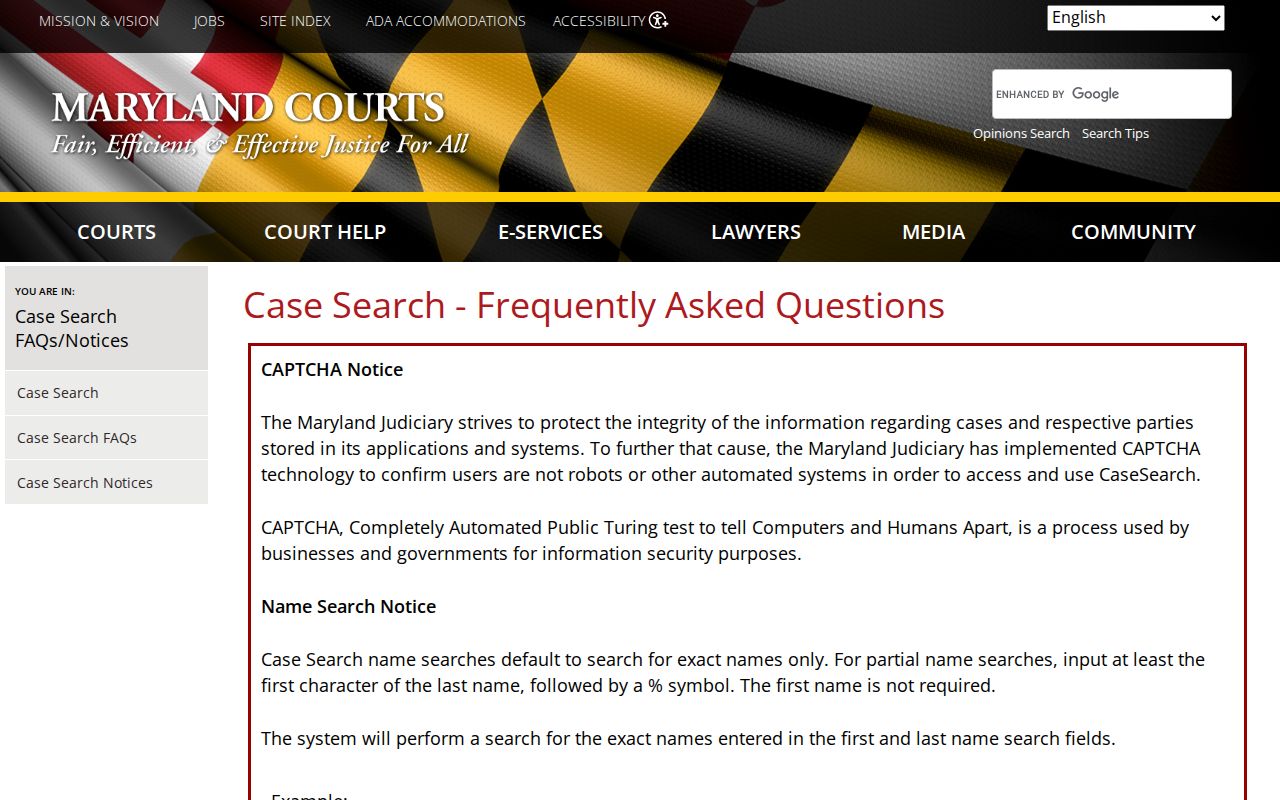
The portal is a strong index, but its own guidance directs users back to the record-holding court for the official file.
Inside Maryland's Court System
Maryland has one high court, one statewide intermediate appellate court, and two trial-court systems. The Supreme Court of Maryland selects most matters by certiorari and also handles rules, discipline, and specified direct matters. The Appellate Court of Maryland hears most appeals from Circuit Courts and certain Orphans' Court matters. These courts were called the Court of Appeals and Court of Special Appeals before December 14, 2022, so older Maryland court records may use the former names.
Circuit Courts are general-jurisdiction and jury trial courts in each county and Baltimore City. They hear felonies, jury cases, major civil claims, divorce, custody, juvenile cases, and appeals from lower tribunals. The District Court of Maryland is one state-funded court with local locations. It has no juries and handles traffic, rent, small claims, limited civil disputes, misdemeanors, specified felonies, and preliminary criminal proceedings. Orphans' Courts and Registers of Wills handle probate. Maryland has no ordinary municipal or justice-court layer.
Typical appeal flow: District Court › Circuit Court › Appellate Court of Maryland › Supreme Court of Maryland. Many Circuit Court cases begin their appeal at the Appellate Court.
| Court | Jurisdiction | Case Types |
|---|---|---|
| Supreme Court of Maryland | Final state review | Certiorari, rules, discipline, certified questions |
| Appellate Court of Maryland | Intermediate review | Most Circuit and selected probate appeals |
| Circuit Court | General and jury jurisdiction | Felony, major civil, family, juvenile, jury trials |
| District Court of Maryland | Limited jurisdiction, no juries | Traffic, rent, small claims, misdemeanors, protective orders |
| Orphans' Court | Probate supervision | Estate disputes, accounts, appointments |
The official Maryland courts directory shows the statewide court structure and local offices.
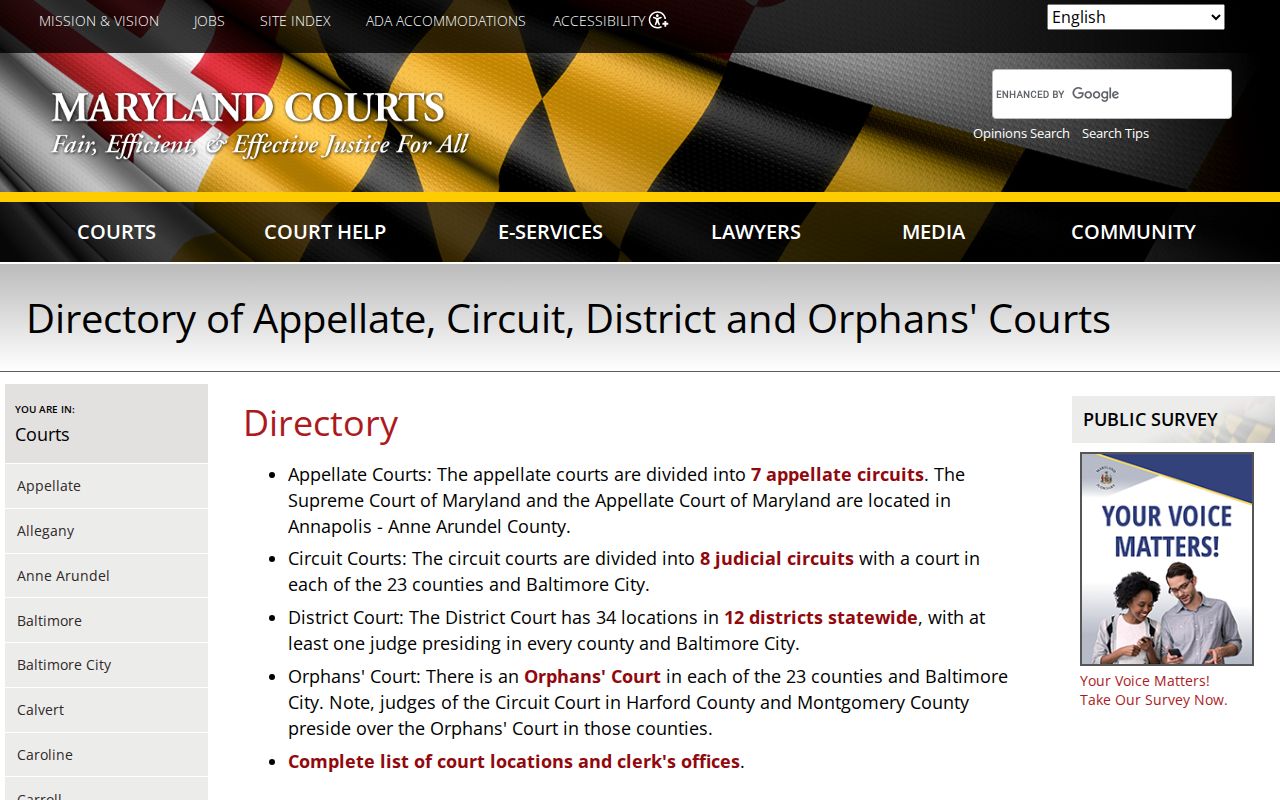
Its filters connect the statewide hierarchy to the clerk, court, or Register serving each local jurisdiction.
Maryland Court Record Types
Maryland court records differ by court and legal issue. Civil files can show a complaint, service, motions, judgment, enforcement, and satisfaction. Criminal files follow accusations through plea, hearings, disposition, and sentence. Family records can include a public docket and final divorce order, while tax returns, financial statements, custody reports, and protected addresses may be restricted. Probate records begin with the Register of Wills and can move before an Orphans' Court judge. Traffic citations are District Court cases, but a driver's license history belongs to the MVA.
- Criminal records show charges, pleas, events, disposition, sentence, and later review.
- Civil records document claims, service, motions, judgments, liens, and satisfaction.
- Family records cover divorce, custody, support, adoption, guardianship, and name changes, with substantial privacy limits.
- Probate records identify estates, wills, personal representatives, inventories, accounts, claims, and orders.
- Traffic records show citations and court outcomes, while reported convictions and points appear in a separate MVA record.
- Appellate records contain briefs, extracts, orders, opinions, mandates, and review history.
The Maryland Judiciary homepage is the central official entry point for court services and forms.
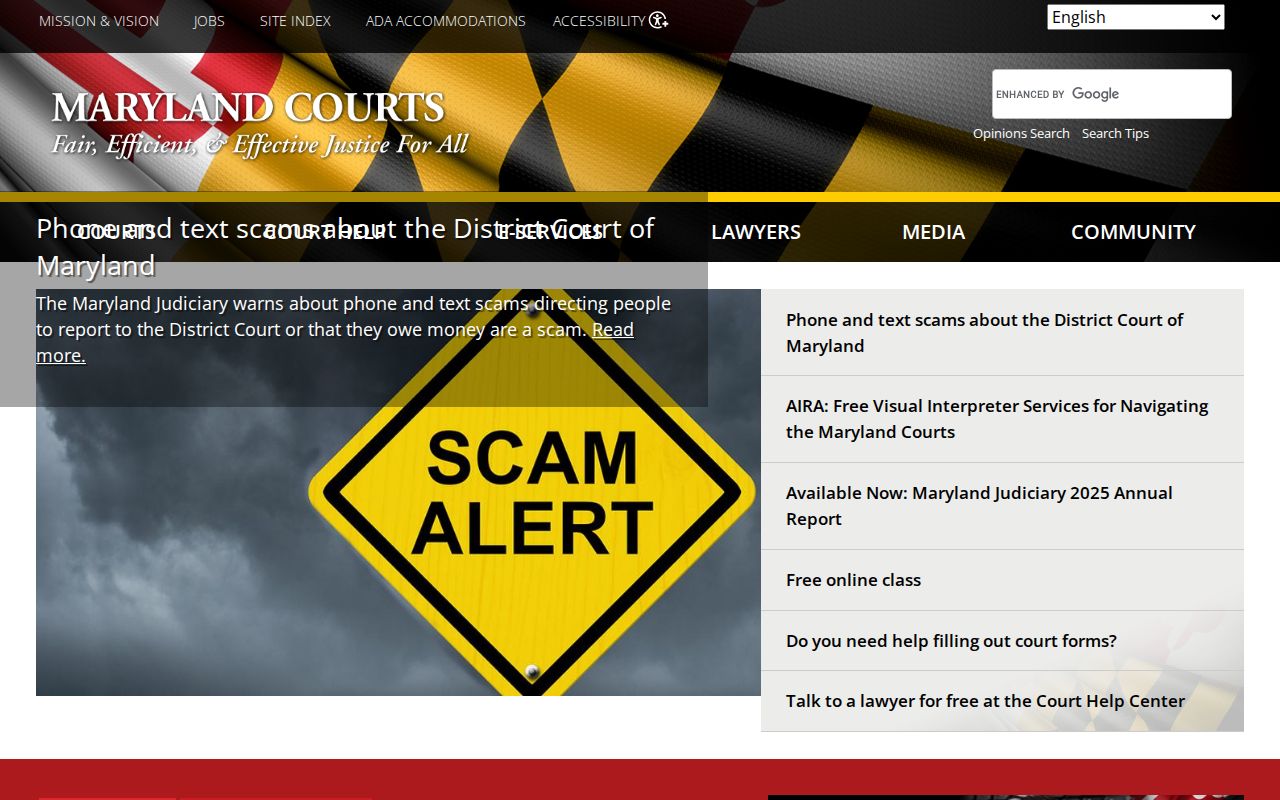
Using the court's own service path helps keep a case search tied to its proper custodian.
What Maryland Court Records Show
A Maryland case summary commonly gives the exact case number, court and location, caption, case category, filing date, current status, parties, lawyers, scheduled events, and dispositions. The detail changes with the case type. Criminal and traffic entries may show counts, statutes, pleas, sentences, fines, costs, and probation. Civil entries may show claim and judgment amounts, service, garnishment, liens, and satisfaction. A docket entry proves that an event was recorded, but not that every underlying document can be downloaded anonymously.
| Field | What It Shows |
|---|---|
| Case number | The court's exact identifier, which should be copied with its displayed punctuation. |
| Filing date | When the clerk opened the case, not necessarily the date of the underlying event. |
| Parties | People or entities and their roles, subject to remote-display and privacy limits. |
| Charges or claim | The accusation, statute, case category, or civil relief recorded by the court. |
| Events | Service, appearances, motions, hearings, postponements, orders, trial, and appeal entries. |
| Disposition | The outcome of each charge or the status and judgment in a civil matter. |
| Sentence or judgment | Incarceration, probation, fines, restitution, money judgment, or other ordered relief. |
Maryland Statewide Record Systems
Several Maryland record systems sit outside the local court file. The DPSCS Incarcerated Individual Locator reports current housing for covered state correctional populations, but it omits many local and short-sentence detainees. CJIS Central Repository provides fingerprint-linked criminal history through authorized processes, not an open public name search. MDOT MVA supplies driving records that compile license status, convictions, points, and administrative action. The Division of Vital Records provides eligible marriage certificates and divorce verifications, while the issuing or filing Circuit Court clerk keeps the original license or decree.
The Maryland sex offender registry is a separate public-safety system. VINE adds custody and selected court-event notifications. None of these systems replaces Case Search or the court clerk, and none is a complete statewide warrant database.
| System | What It Holds | Run By |
|---|---|---|
| DPSCS Incarcerated Individual Locator | Current location for covered state custody | Maryland DPSCS |
| CJIS Central Repository | Fingerprint-linked Maryland criminal history | Maryland DPSCS |
| myMVA and DR-057 records | License status, reported convictions, points, and actions | MDOT MVA |
| Division of Vital Records | Eligible marriage certificates and divorce verifications | Maryland Department of Health |
| EstateSearch | Statewide probate estate index | Registers of Wills |
Maryland Court Records Access Law
Maryland separates judicial case-record access from ordinary agency public records. Maryland Rule 16-902 states a policy favoring open judicial records unless a constitution, rule, law, court order, or case law restricts access. Rules 16-901 through 16-914 address custodians, requests, remote access, courthouse access, excluded material, and reasonable fees. The Maryland Public Information Act applies broadly to public agencies, but a PIA request cannot override a court sealing order or the Judiciary's case-record rules. Ask the custodian to identify the rule or statute when access is denied.
Key Statutes:
General Provisions § 4-201 creates the general right to inspect a public record, subject to exceptions.
Maryland Rules 16-901 through 16-914 govern requests, access levels, exclusions, custodians, and fees for judicial records.
Criminal Procedure § 10-105 defines qualifying criminal dispositions and circumstances for expungement.
Criminal Procedure § 10-301 et seq. defines Maryland's Second Chance shielding process for specified convictions.
The Judiciary's court-record access overview distinguishes remote summaries, courthouse electronic documents, and paper files.
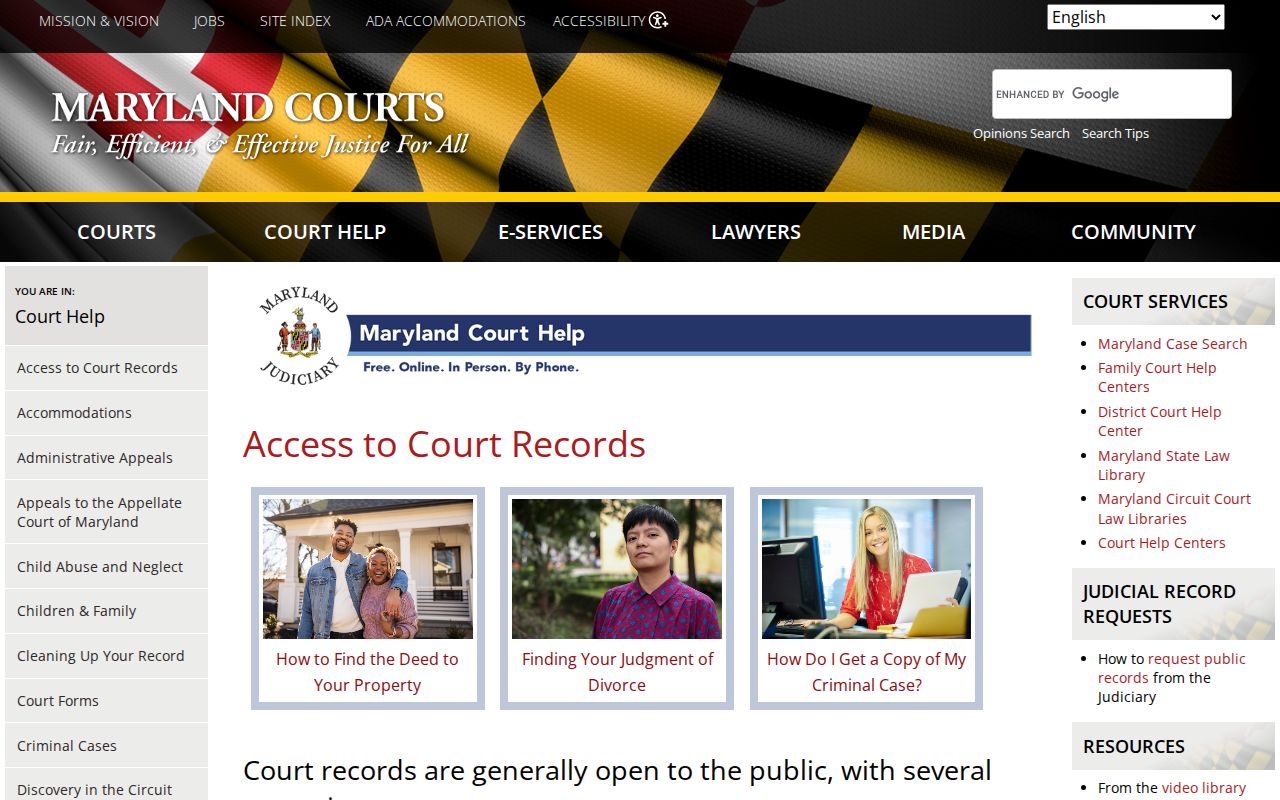
That distinction explains why a public document can be available at a kiosk even when no PDF appears in an anonymous search.
Restricted Maryland Court Records
Some Maryland files are closed in full, including adoption, juvenile delinquency, children-in-need-of-assistance matters, and guardianships that terminate parental rights. Other cases remain public while a tax return, family financial statement, physician report, fee-waiver request, or guardian property report is restricted. Social Security numbers, account numbers, protected addresses, abuse-reporter identities, and some minor information must be redacted. Filers use form MDJ-008 to identify protected information in otherwise public filings.
Sealing, shielding, and expungement are not synonyms. A seal follows a court order or governing rule. Shielding removes eligible material from public view while authorized access can remain. Expungement directs removal of qualifying court and police records. Current remote-display rules can also hide some favorable or old stet charges even when an unexpunged public record remains available at the courthouse.
The official restricted-information guidance identifies Maryland's protected data categories.
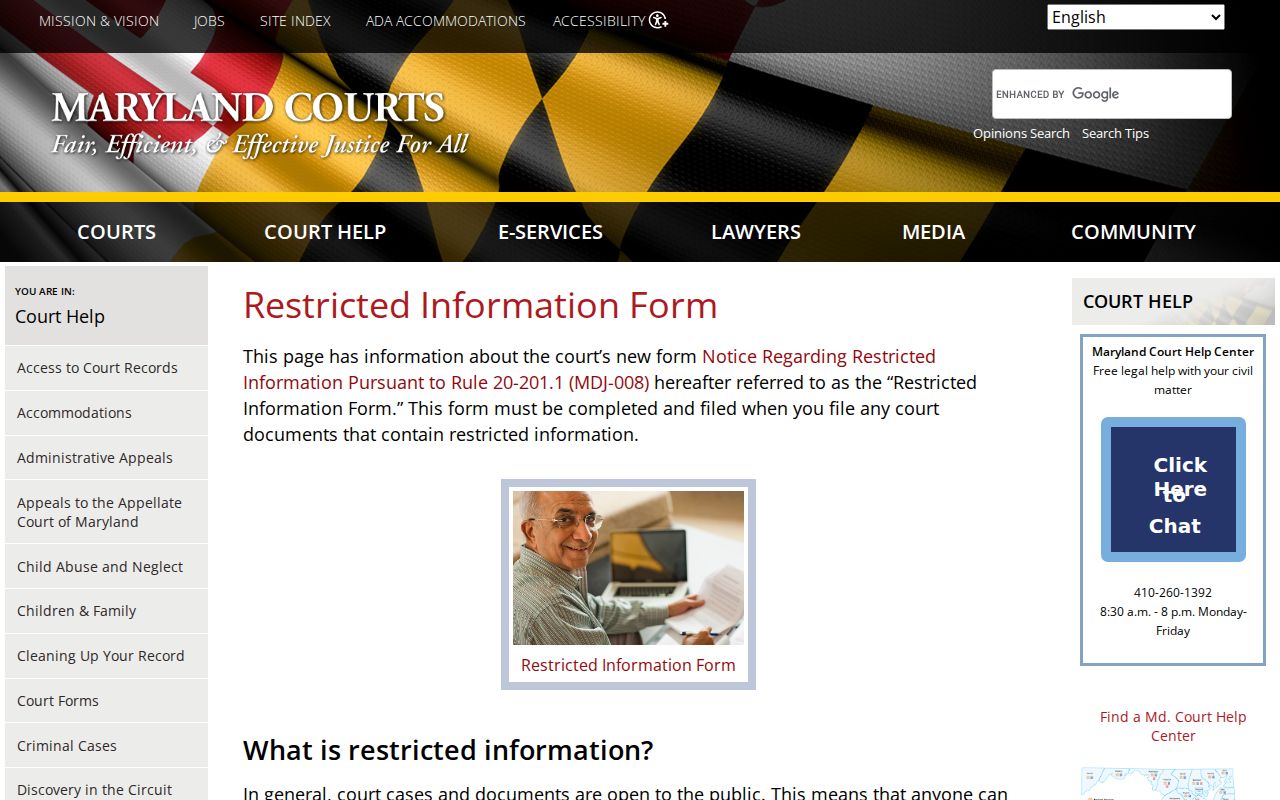
Separating an entirely closed case from one protected document helps requesters ask for the public docket and any segregable portions.
Maryland's adult expungement materials list the forms, fees, and outcome-based paths.
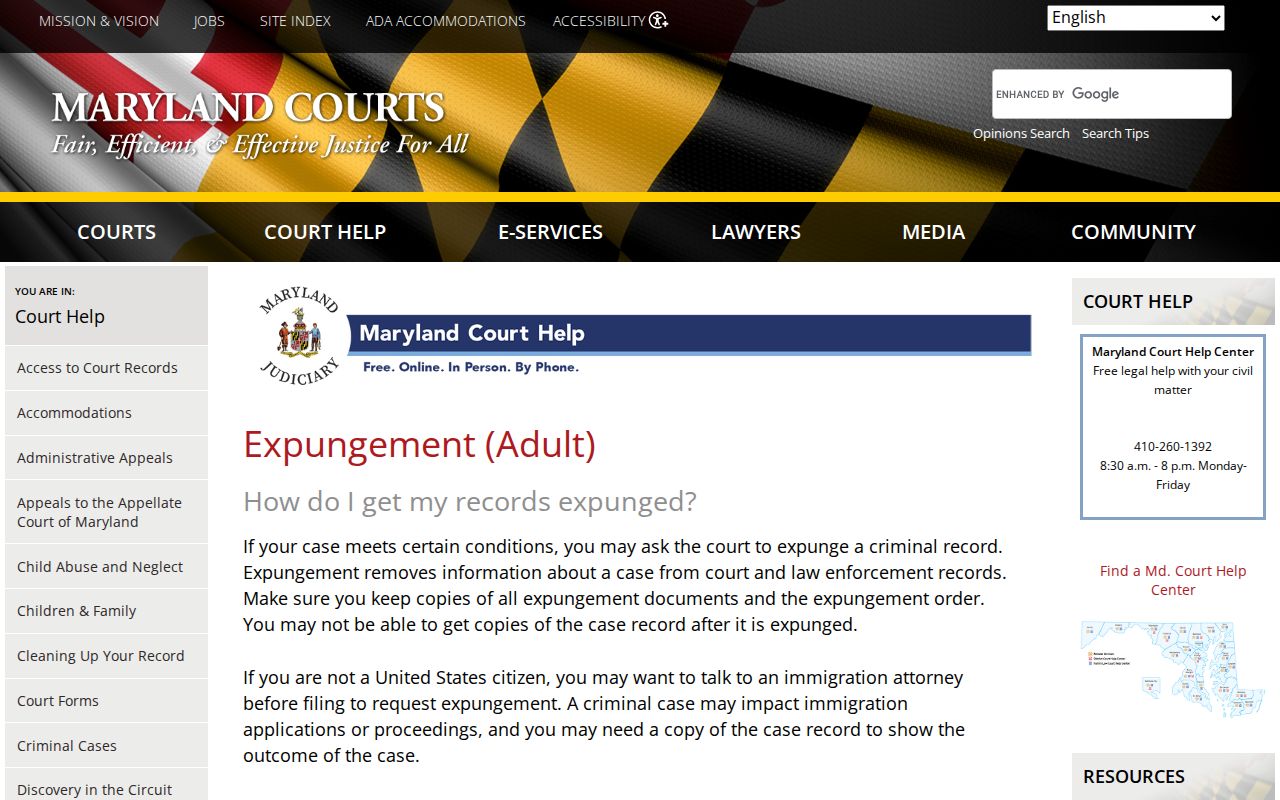
A certified disposition should be obtained before pursuing cleanup because public access may disappear after an order is carried out.
Find Maryland Court Records Locally
Trial records belong to the court location where the matter was filed. Maryland has 23 counties plus Baltimore City as an independent records jurisdiction. The six largest project jurisdictions below cover major parts of the Baltimore-Washington region, yet the correct route is always the location named on the case. Local pages connect readers with the Circuit clerk, District Court, Register of Wills, jail, and warrant custodian for that place.
Montgomery County
Rockville · Largest county and Sixth Judicial Circuit jurisdiction
Prince George's County
Upper Marlboro · Major Seventh Judicial Circuit caseload
Baltimore County
Towson · Third Judicial Circuit and county detention system
Baltimore City
Baltimore · Independent city with state-operated pretrial detention
Anne Arundel County
Annapolis · State capital and home of Maryland appellate courts
Howard County
Ellicott City · Fifth Judicial Circuit metro jurisdiction
Browse the full directory of all 24 Maryland jurisdictions to open the local court records site for any county or Baltimore City.
Maryland Court Records Fees
Online Case Search and EstateSearch indexes are free. Courthouse inspection is ordinarily free, and judicial-record work requiring under two employee hours generally has no access labor charge unless another law permits it. Copies, certification, exemplification, retrieval, and longer staff work can cost money. A representative official Circuit Court schedule charges $0.50 per page, commonly adds $5 for certification, and adds $10 for exemplification. The exact record and office can change the charge, so obtain a written estimate before mailing payment.
| Item | Amount |
|---|---|
| Case Search or EstateSearch summary | $0 |
| Judicial inspection labor under two hours | Generally $0 |
| Representative Circuit plain copy | $0.50 per page |
| Representative Circuit certification | $5 plus copies |
| Representative Circuit exemplification | $10 plus copies |
Interpret Maryland Court Records
Read a Maryland docket by date and by count. A charge is an accusation; it is not a conviction. A plea states the defendant's response. The disposition gives the outcome for that count. Nolle prosequi means the State declined further prosecution at that time. Stet places a charge on an inactive docket subject to legal conditions. PBJ means probation before judgment, a Maryland result distinct from an entered judgment of conviction. A postponement changes the event date but decides nothing. Criminal sentences should be read for imposed time, suspended time, probation, fines, restitution, and concurrent or consecutive terms.
- Disposition
- The outcome of a charge or case.
- Mandate
- The appellate court's formal direction returning the case after review.
- Satisfaction
- An entry showing that a civil judgment has been paid or otherwise resolved.
- Shielding
- Removal from public view while authorized access may remain.
Maryland Record Limits and Updates
Case Search data can appear soon after clerk entry, but timing varies. Older records may remain on paper, film, or in an archive. Appellate online coverage has defined modern start points, and protected case types do not appear. Minor closed District traffic cases move out of remote display after 36 months. Certain favorable criminal outcomes and older stet charges can also be absent remotely while still available for courthouse inspection unless another restriction applies.
The Judiciary announced its integrated Case Search and Record Portal for March 14, 2026.
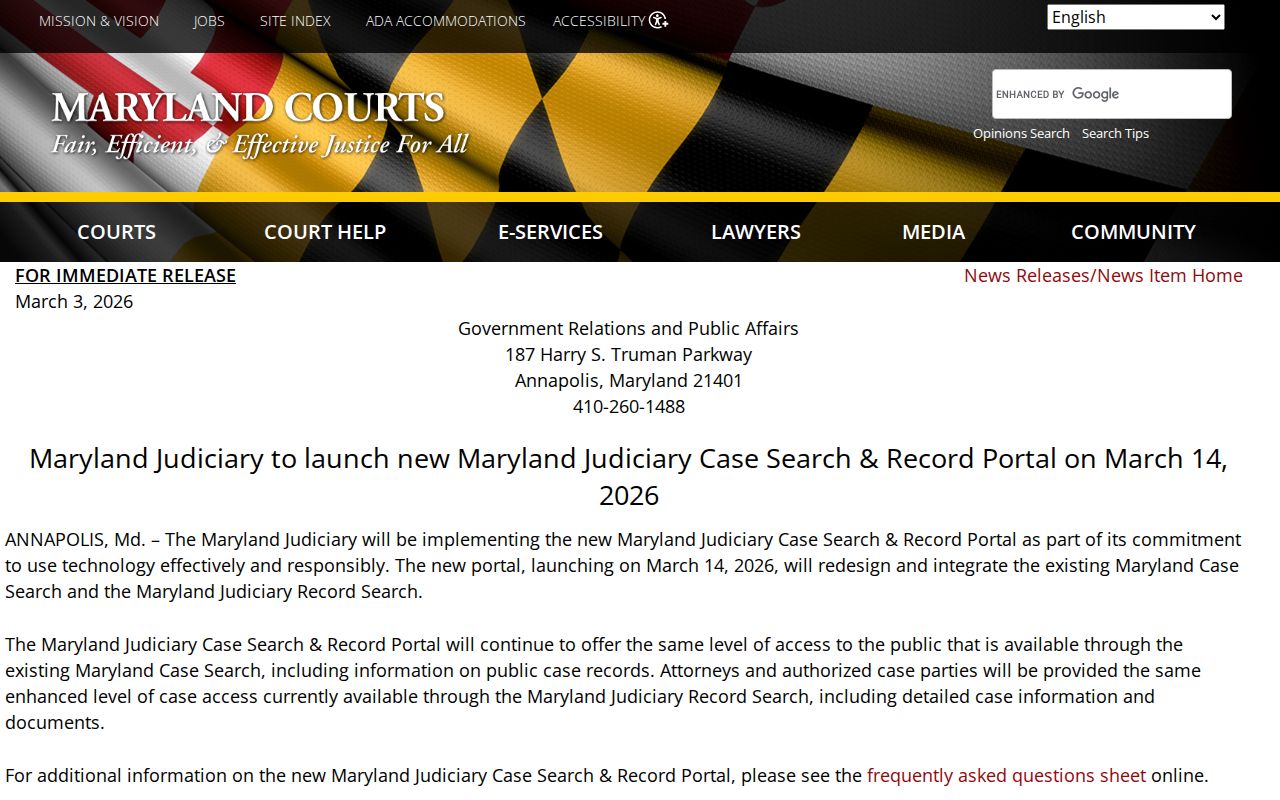
The redesign joined public search with authenticated record access but did not expand anonymous users' right to every electronic document.
Note: Confirm identity, status, and the latest order with the Maryland clerk before relying on a portal result.
Maryland Courts Past and Present
Maryland's modern statewide District Court began July 5, 1971, replacing a patchwork of justices of the peace, magistrates, and local courts. That unification explains why ordinary traffic, rent, small-claim, and misdemeanor cases now sit in one District Court system even though hearings occur at local sites. Circuit Courts retained their county and Baltimore City base, elected clerks, and eight judicial circuits. Orphans' Courts remain a distinct Maryland probate institution.
The Judiciary's District Court history explains the statewide court's jurisdiction and origins.
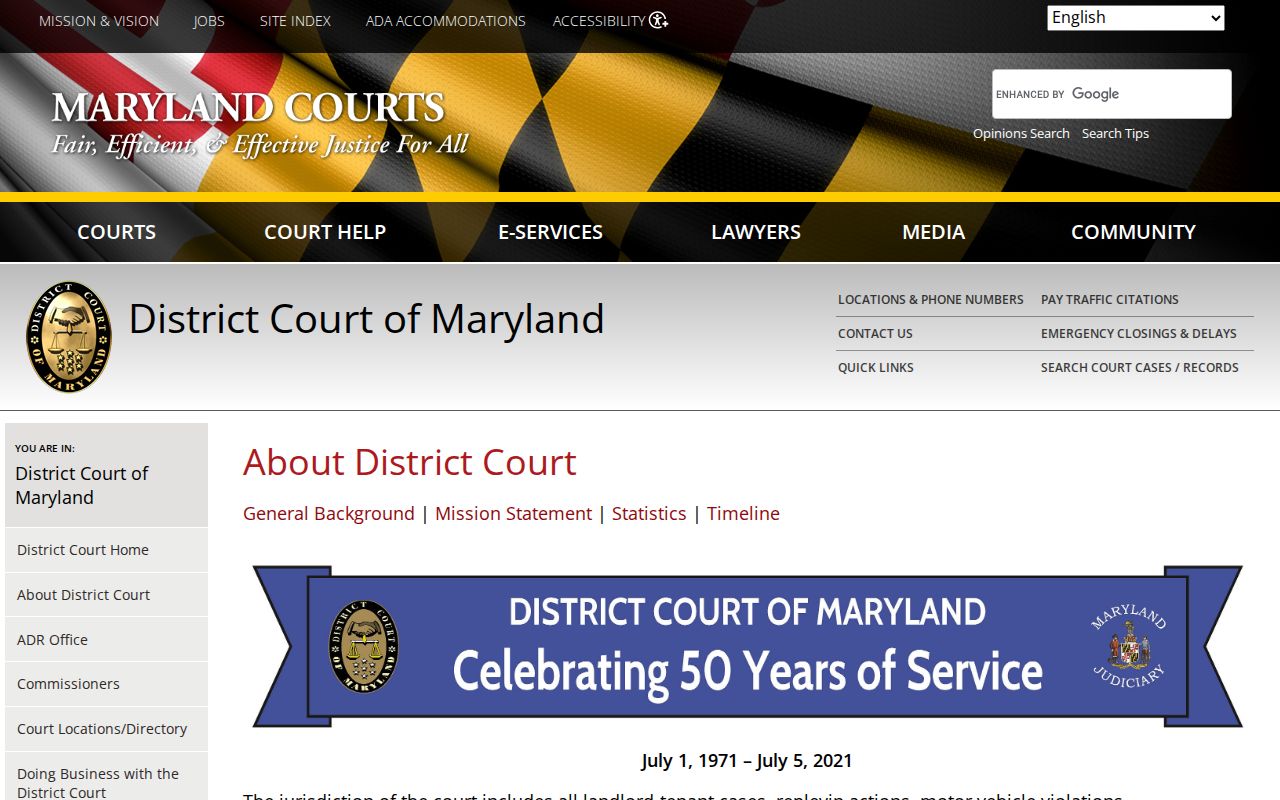
The older names of former local courts can still appear in archived Maryland court records, deeds, and citations.
The Appellate Court of Maryland is the current name of the former Court of Special Appeals.
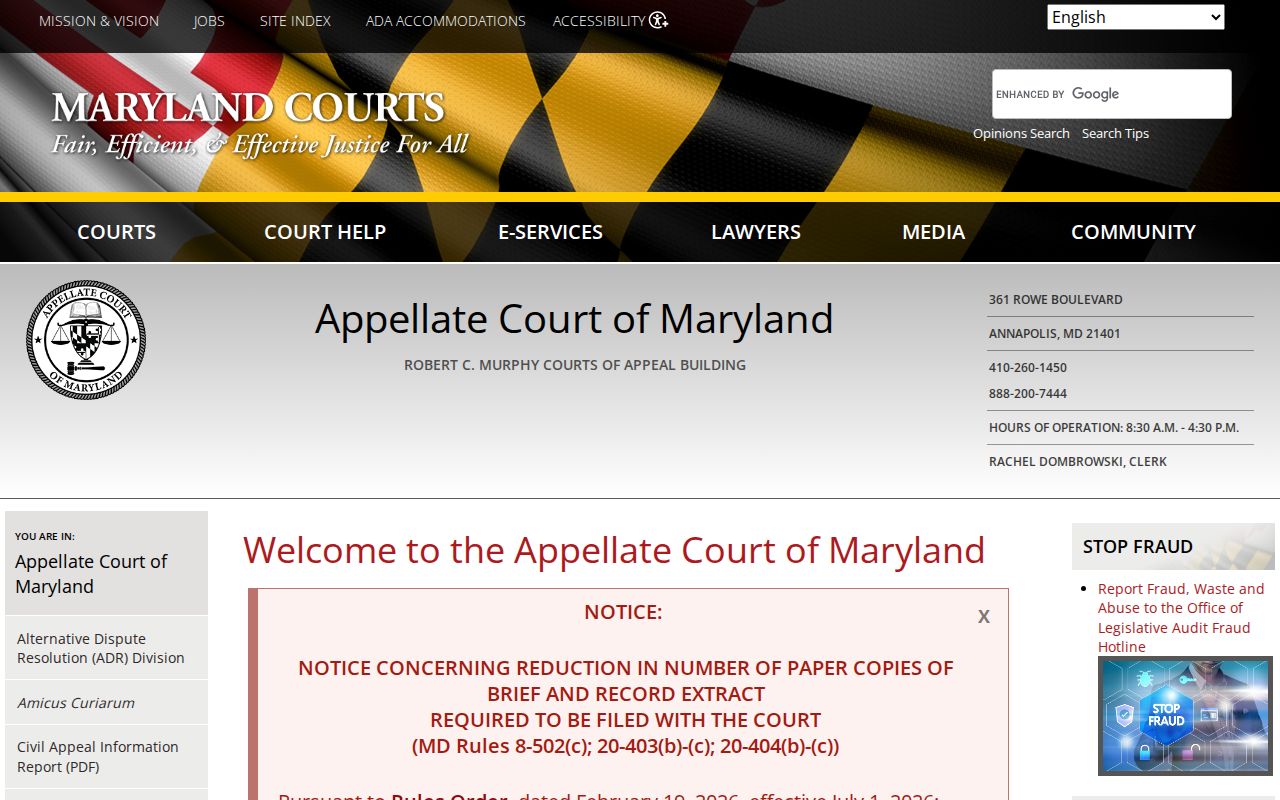
Searching both current and former court names can help locate opinions and docket references created before the 2022 renaming.
Maryland Traffic Record Choices
Maryland District Court gives a person with a payable citation four basic responses within 30 days: pay, request an installment plan, request a waiver hearing, or request a trial. Must-appear cases such as DUI/DWI or driving while suspended cannot be closed by simply paying. The court owns the citation record. MDOT MVA owns the separate driving record and applies reported conviction, point, suspension, and restoration consequences.
The Judiciary's statewide traffic instructions describe the current response channels.
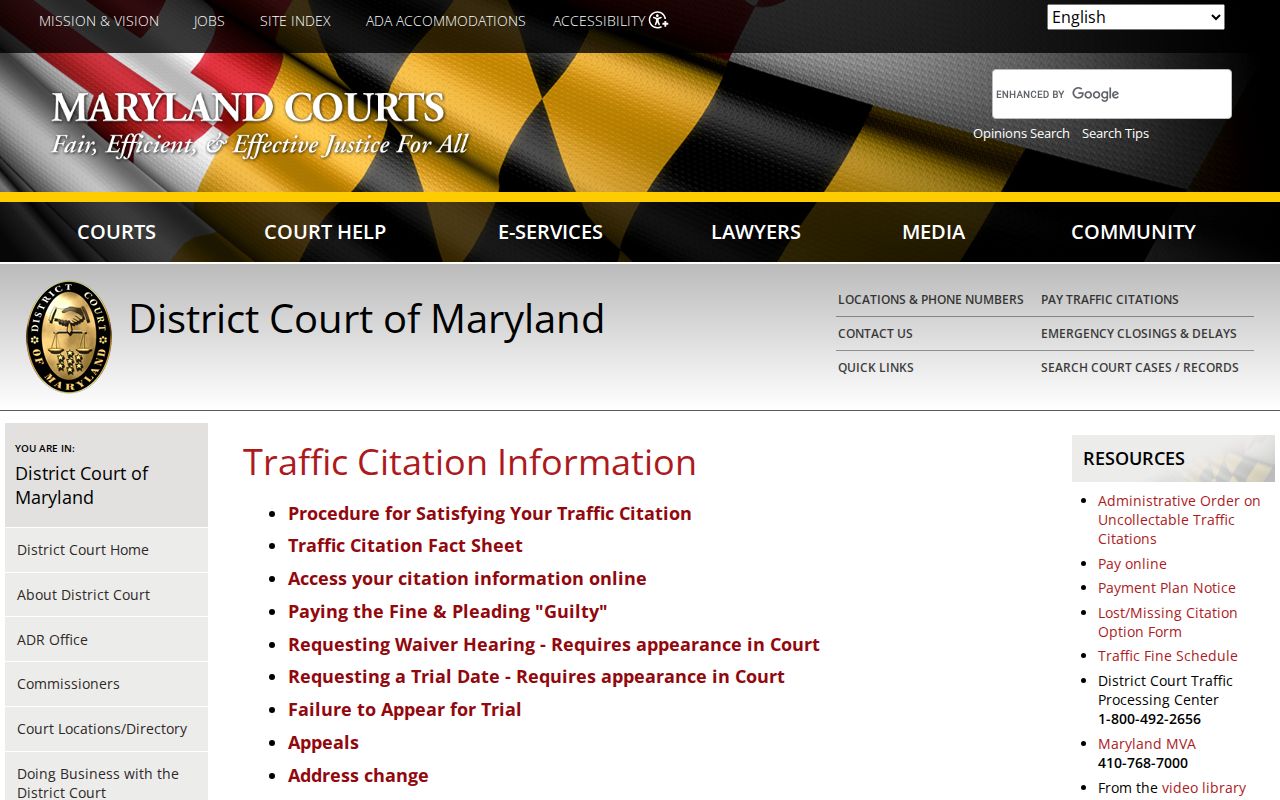
Maryland Online Resolutions is not accepting new cases, so current users must choose among the remaining official court options.
Maryland Court Records Questions
Are Maryland court records free online?
Case Search summaries and EstateSearch indexes are free. Anonymous access normally provides selected case data rather than every filed PDF. Public electronic documents may be available at a courthouse kiosk, and a clerk can charge for copies, certification, retrieval, or longer staff work.
Why is a known Maryland case missing?
Try the exact case number, spelling variants, fewer filters, and the former appellate court names. The file may predate local automation, be restricted, or fall under a remote-display rule. Ask the clerk whether it exists on paper, film, in an archive, or at a courthouse access level.
Does Case Search provide a background check?
No. The Judiciary warns against using Case Search as an individual background check. It is name based and can produce namesakes or incomplete remote results. Maryland CJIS uses fingerprint-linked review for authorized criminal-history purposes, while a certified court disposition proves the outcome of a specific case.
Where can certified Maryland court records be ordered?
Order from the clerk or Register that holds the file. Give the court, exact case number, caption, document title, date, and whether a plain, certified, or exemplified copy is needed. Confirm the price, payment method, delivery choice, and archive retrieval time before sending a request.
Are Maryland probate records in Case Search?
Use EstateSearch for the statewide probate index. The local Register of Wills keeps the estate papers and provides certified copies. An Orphans' Court handles judicial or disputed probate matters, but the Register remains the operational file custodian.
Can a public record still be unavailable remotely?
Yes. Maryland rules distinguish remote public access from courthouse access. A document can be public at a kiosk or clerk's office without being available to an anonymous online user. Ask for the nonrestricted docket and segregable portions if only part of a filing is protected.