
Maryland Arrest Records and Charges
Maryland arrest records arise when police take a person into custody and record identity, arrest time, agency, initial allegations, fingerprints, photograph, property, and custody status. Those agency and booking records do not show that a prosecutor pursued every arrest allegation. A District Court commissioner may issue a statement of charges, and the State’s Attorney may amend, decline, dismiss, nolle pros, or pursue the matter.
The court charge record begins with a filed complaint, statement, information, indictment, or citation. The clerk assigns a case number and records each count, statute, plea, and status. Booking detail remains with the arresting agency or detention custodian, while the filed prosecution belongs to the District or Circuit clerk. The Maryland custody search is the proper route for current jail or prison location; the court record shows charges after arrest and their later outcomes.
Find Maryland Arrest Records and Charges
Use Maryland Judiciary Case Search and Record Portal for filed District and Circuit charges. Use the arresting police agency or local detention office for the arrest and booking record. Maryland has no complete public statewide arrest-name database. The incident jurisdiction, exact name, birth data where lawfully available, arrest date, agency, and known number help distinguish matches.
- Search Case Search by defendant name or exact case number.
- Filter by District or Circuit Court, criminal type, jurisdiction, and filing date.
- Open the case and read every count, statute, plea, and disposition.
- Contact the filing clerk for the statement, information, indictment, or certified result.
- Contact the arresting or detention agency separately for releasable booking details.
Current remote-display rules matter. Charges ending in dismissal, acquittal, not guilty, or nolle prosequi may not appear online, and a stet charge disappears from remote display after three years. The unexpunged file can still be public at the courthouse. A missing Maryland arrest or charge result therefore does not establish that no arrest or court case occurred.
Maryland Charging Documents After Arrest
Maryland charges can begin through a commissioner, prosecutor, grand jury, or officer-issued citation. A complainant may submit an Application for Statement of Charges, after which a commissioner decides probable cause and whether to issue a summons or warrant. A State’s Attorney screens the evidence. Serious felonies can proceed in Circuit Court by indictment or information.
| Complaint | Information | Indictment | |
|---|---|---|---|
| Source | Officer, complainant, or commissioner process | State’s Attorney | Grand jury |
| Typical Court | District Court | Circuit Court where authorized | Circuit Court |
| Function | States accusation and probable-cause basis | Formal prosecutor-filed counts | Grand jury returns formal counts |
| Meaning | Accusation, not guilt | Accusation, not guilt | Accusation, not guilt |
Charge Status and What It Means
Charge status changes as prosecutors and courts act. Each count must be read separately. A case can include an amended charge, a dismissed count, a guilty plea on another count, and a merged count at sentence. Maryland does not use a universal Class A or Class B ladder, so quote the code section, description, degree, and exact recorded outcome.
| Status | What It Means |
|---|---|
| Pending | No final Maryland court outcome has been entered. |
| Amended or Reduced | The filed accusation changed; compare original and final counts. |
| Dismissed | The court ended that count as recorded. |
| Nolle Prosequi | The State declined further prosecution at that time. |
| Stet | The count is inactive under conditions and can be reopened. |
| PBJ | Probation before judgment, distinct from conviction and dismissal. |
| Merged | The count was combined for sentencing treatment. |
Maryland Charges Versus Convictions
An arrest shows custody. A charge shows an accusation. A conviction shows a guilty judgment after a plea or adjudication. These are not synonyms. Maryland records may retain nonconviction events unless a restriction, shielding law, expungement, or current remote-display rule applies. Accurate reporting states each count’s final outcome and does not treat the arresting allegation as the final court charge.
| Charge | Conviction | |
|---|---|---|
| Stage | Accusation | Verdict or plea |
| Burden of Proof | Probable cause | Beyond reasonable doubt |
| Outcome | Can be amended, dismissed, acquitted, or placed stet | Guilty judgment entered |
| Proof | Filed charging paper and current docket | Certified disposition or judgment |
Maryland Shielded Versus Expunged Records
Maryland uses shielding and expungement for different effects. Second Chance shielding hides specified convictions from ordinary public access while authorized users retain access. It generally requires three years after completion of sentence and is limited to one granted petition in one chosen court and county. Expungement removes qualifying court and police records under the applicable statute and order.
| Sealed | Expunged | |
|---|---|---|
| Visibility | Hidden from ordinary public view | Removed as Maryland law directs |
| Authorized Access | Law enforcement and specified users retain access | Later retrieval is narrow and difficult |
| Eligibility | Specified convictions and statutory conditions | Outcome-specific rules, waiting periods, and unit rules |
| Fee | No fee | Usually $0 favorable; $30 per eligible guilty case |
Read Maryland Charge Codes
Case Search can show count sequence, charge description, Maryland Code article and section, offense date, probable-cause category, plea, disposition, and disposition date. One arrest can generate several counts at different levels. District Court hears misdemeanors, specified felonies, and preliminary matters. Circuit Court handles indictments, serious felonies, and jury trials. A jury demand can move a District case into Circuit Court.
Copy the displayed statute and degree exactly. Do not infer the maximum penalty or collateral effect solely from “misdemeanor.” PBJ can have different licensing, immigration, MVA, and expungement effects. Likewise, “forwarded” or a closed District file may point to a still-pending Circuit indictment rather than a final dismissal.
Maryland Statewide Criminal History
The DPSCS Criminal Justice Information System Central Repository, or CJIS-CR, compiles fingerprint-linked Maryland arrest and disposition submissions. It is not an anonymous public name search. Subjects can request a personal review. Employers and licensing bodies must use an authorized purpose, agency authorization number, consent process, identity documents, and fingerprints. The regulatory Maryland CHRI access fee is $18, with CJIS, FBI, LiveScan, and private-provider components varying by purpose.
CJIS history, court file, and booking record can differ because they have distinct custodians, update paths, and legal uses. Resolve court errors with the clerk, then provide certified disposition through the CJIS challenge route when needed. For source papers, use the directory of Maryland jurisdictions and contact the court shown in Case Search.
Background Check Considerations
Case Search warns against using its name results as individual background checks. Namesakes and remote omissions can mislead. Formal consumer reports used for employment, housing, credit, or insurance must satisfy the FCRA and other applicable rules, including permissible purpose and adverse-action duties. An authorized fingerprint-based CJIS process is the Maryland route for identity-linked history where law permits it.
Important: A Maryland arrest or name match is not a conviction and is not an identity-verified consumer background report.
Restricted Maryland Charge Records
Juvenile files, sealed matters, expunged records, protected addresses, Social Security numbers, medical and financial identifiers, victim details, and specified investigation material are not open to casual inspection. A prosecutor’s work product or active police file is not made public merely because a related charge appears in Case Search. Ask for the public charging document, docket, and segregable portions rather than an unrestricted investigation file.
The manifest links the DPSCS incarcerated individual locator, a separate custody system.
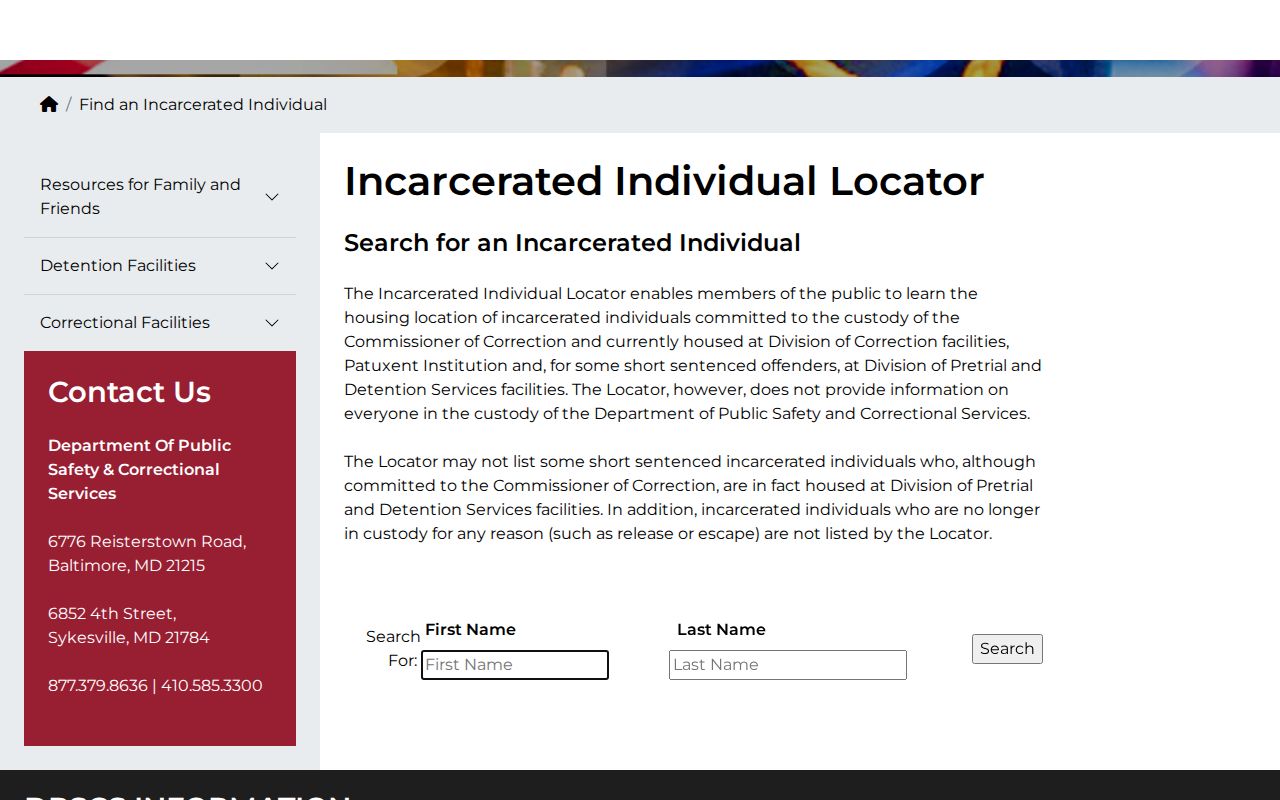
A custody result can locate a person but does not replace Maryland arrest records, court charges, or certified dispositions.
Federal Maryland prosecutions are also separate. The manifest’s U.S. Attorney for the District of Maryland source identifies the federal prosecuting office.
Federal charges use federal courts and PACER, while state charges use Maryland District or Circuit Court records.
To verify a state charge, save the exact court and case number, then ask the clerk for the charging instrument and certified disposition. If the charge is missing online, ask whether it is older, remotely withheld, shielded, sealed, or expunged. A precise request and cost cap can reduce search and copy fees.
One Maryland incident can also cross several systems. Police may record an arresting allegation, a commissioner may issue different counts, and the State’s Attorney may later amend or replace them. A grand-jury indictment can create a Circuit Court number after the District file appears closed or forwarded. The detention roster may still show a holding charge while the court docket has changed. Compare dates, agencies, tracking numbers, and cross-references before concluding that two records describe different people or that the first allegation remained the final charge.
Errors should be challenged at their source. Ask the arresting agency about its booking data, the clerk about the filed court record, and CJIS about the fingerprint-linked history. A corrected court outcome may need a certified disposition before CJIS can update a missing or wrong result. Preserve copies and retrieval dates throughout the process. A portal screen can change after correction, while a certified Maryland disposition states what the clerk certified on the issue date and gives another custodian a dependable basis for review.
Release and bond data also need context. A cash, surety, unsecured, or recognizance entry states conditions for release and appearance, not guilt. A commitment event can be followed by release, transfer, a second jurisdiction’s hold, or federal custody. The booking office may know current physical custody, while the clerk holds the bond order and court events. When the person cannot be found in one system, compare the release date, destination, active case numbers, and any detainer rather than assuming the court charge was dismissed.
Public-record requests are not a fast substitute for real-time warrant or safety checks. Police may withhold active investigation details, victim addresses, intelligence, or information whose release would harm enforcement. Narrow an agency request by incident date, person, record type, and preferred electronic format, then ask for segregable public portions and the cited exemption for anything withheld. For the filed accusation, the Maryland court clerk is usually the clearer source. For urgent legal risk, counsel can verify the case and advise on appearance, surrender, or a motion without relying on a broad records request.