
Search Maryland Court Records
Maryland Judiciary Case Search and Record Portal is the broad public starting point. It indexes all Maryland Circuit and District case-management systems and modern appellate matters. District coverage includes civil, criminal, and traffic cases. Circuit coverage includes civil, criminal, and publicly displayable family matters. Supreme Court term coverage begins with 2015, while Appellate Court coverage begins with 2016. Older Maryland court records may exist even when no online result appears.
Prepare the full recorded name, possible former names, the filing jurisdiction, and a case or citation number when known. A number search is best because names can match several people. Search results identify the court location and case number needed for the next request. The local Circuit Court clerk, District Court clerk, or appellate clerk remains the custodian of pleadings, orders, exhibits, recordings, and certified Maryland court records.
- Open the portal, read its terms, acknowledge them, and continue to the search form.
- Choose a name or number search. Add court, case type, county, or date filters.
- Open the match and record its exact number, court location, status, parties, and filing date.
- Use a courthouse public kiosk for public MDEC documents hidden from anonymous remote users.
- Ask the filing clerk for named documents and specify plain, certified, or exemplified copies.
The Judiciary Case Search FAQ explains coverage, timing, and omissions. Data can appear almost at once after clerk entry, but local entry time varies. The portal gives selected information, not the official complete record, and the Judiciary warns against using it for an individual background check.
Maryland Court Record Search Fields
The statewide form supports broad discovery and exact retrieval. Optional filters matter when a common name returns many Maryland court records. A trailing percent sign can broaden a partial first name, but it cannot begin or split a word. Citation numbers are entered as case numbers with Traffic and District Court selected.
| Field Label | Type | Required | Notes / Format |
|---|---|---|---|
| Court System | Radio or dropdown | Yes or unspecified | Circuit Court, District Court, both, or appellate interface. |
| Case Type | Dropdown | No | Civil, criminal, traffic, and compatible categories. |
| First and Middle Name | Text | No | Middle name refines identity; trailing % broadens a first name. |
| Last Name or Company | Text | Yes for name route | Use the spelling recorded by the court. |
| Party Type and Exact Match | Dropdown and checkbox | No | Refine by role and reduce variants. |
| County and Filing Dates | Dropdown and dates | No | Narrow jurisdiction and filing period. |
| Case Number | Text | Yes for number route | Preserve punctuation; traffic citation numbers work. |
The official Maryland court-record resource distinguishes paper, electronic, remote, and courthouse access. That distinction explains why a valid public file may not appear in an anonymous online search.
Types of Maryland Court Records
Maryland divides trial work between Circuit Courts and the statewide District Court. District Court handles traffic, landlord-tenant, replevin, small claims through $5,000, civil claims through $30,000, misdemeanors, specified felonies, and preliminary criminal events. Circuit Courts hear jury trials, serious criminal cases, civil claims over $30,000, divorce, custody, juvenile cases, and lower-court appeals. The Register of Wills keeps probate estate files, while an Orphans’ Court supervises contested or judicial estate matters.
Record type determines both the office and the access limit. Family files can have a public docket but restricted financial or custody material. Juvenile, adoption, and CINA files are generally closed. Probate begins in EstateSearch, not Case Search. Appellate records can include petitions, briefs, opinions, orders, and mandates. Maryland court records commonly include:
- Civil complaints, service returns, motions, judgments, garnishments, and satisfactions.
- Criminal charging papers, bond events, pleas, dispositions, sentences, and appeals.
- Family complaints, public orders, divorce judgments, and protected supporting records.
- Traffic citations, hearings, pleas, fines, court costs, and reported convictions.
- Probate petitions, wills, inventories, claims, accounts, and estate orders.
What Maryland Court Records Show
A public result is a structured index. Maryland case-number formats differ by court and type, so copy the displayed number exactly. An appellate number may end in a term year, and a District traffic number may begin as the citation number. Metadata can establish filing place and recorded outcome, but it does not replace the signed order or full pleading.
| Field | What It Shows |
|---|---|
| Case Number and Court | Exact identifier, court level, location, and Maryland jurisdiction. |
| Caption and Filing Date | Case title, category, filing date, and current status. |
| Parties and Counsel | Names, roles, and attorney appearances within display limits. |
| Claims or Charges | Civil claim data or criminal counts, statutes, and dates. |
| Docket Events | Filings, service, motions, hearings, orders, and appeals. |
| Disposition or Judgment | Outcome, date, judge, amount, plea, verdict, or sentence. |
| Financial Entries | Fines, costs, restitution, principal, liens, or satisfaction. |
For another view of published opinions and dockets, the manifest documents the nonprofit Free Law Project service.
This secondary research tool can help locate opinions, but only a Maryland clerk can certify the originating court record.
Maryland Court Record Access Rules
Maryland Rule 16-902 favors access unless a constitution, rule, statute, case law, or court order restricts it. Rules 16-901 through 16-914 define custodians, requests, remote access, courthouse access, exclusions, and reasonable fees. The Maryland Public Information Act establishes broader public-record access but does not displace Judiciary rules for case files.
Inspection is generally free. Judicial access work taking less than two employee hours generally has no labor charge unless other law permits one. Copies, certification, retrieval, and longer work can cost more. A representative Circuit copy is $0.50 per page, with $5 commonly added for certification and $10 for exemplification. The record-specific schedule controls. Request an estimate before mailing payment. Photo ID or proof of authority may be required for party-only material.
Note: A precise case number and document date can reduce search time, redaction work, delay, and the cost of Maryland court records.
The manifest’s official judicial-record access FAQ shows the practical request framework.
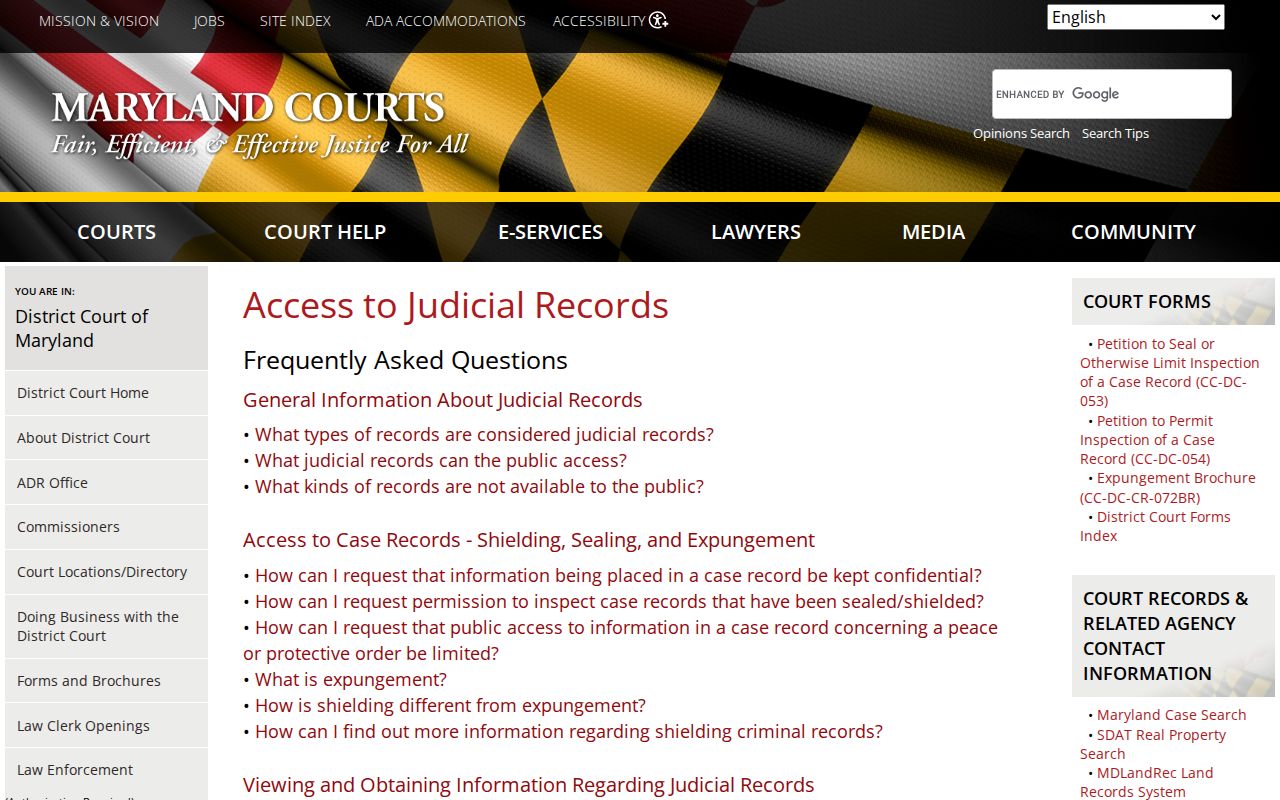
The statewide rules apply across Maryland, while the clerk at the filing court handles the request and local payment instructions.
Restricted Maryland Court Records
Maryland restricts entire adoption, juvenile delinquency, CINA, and parental-rights guardianship files. Public cases can also contain closed documents, including tax returns, family financial statements, fee-waiver requests, physician reports, and guardian reports. Social Security numbers, account data, abuse reporter identities, protected addresses, and minor identifiers are redacted. MDJ-008 flags restricted information; it does not make a whole public case secret.
Sealing, shielding, and expungement differ. A sealing order blocks access as directed. Second Chance shielding hides eligible convictions from public view but preserves authorized access. Expungement removes qualifying court and police records. Current remote-display changes also remove certain dismissed, acquitted, not-guilty, and nolle prosequi charges online while an unexpunged file can remain open at the courthouse. A missing result does not prove that a Maryland court record never existed.
Find Maryland Court Record Custodians
Maryland has 24 local court jurisdictions: 23 counties plus independent Baltimore City. Use the Maryland jurisdiction directory after Case Search identifies the filing location. Circuit clerks keep serious criminal, jury, major civil, family, and lower-court appeal files. District clerks keep traffic, rent, limited civil, misdemeanor, peace-order, and protective-order files. Registers of Wills keep probate records. The Maryland clerk overview explains these duties.
If no result appears, retry spelling variants and fewer filters. Then call about archived paper, film, a restricted MDEC level, or a moved file. Inspect public documents at the counter or kiosk. A mail request should name the caption, number, documents, date range, copy type, delivery method, cost limit, and contact information.
Older Maryland court records need a deliberate fallback. Ask whether the clerk still holds the file or whether a box, film reel, or other archived format must be retrieved. Confirm the expected turnaround, page count, accepted payment, postage, and whether certification is available before sending money. If the file is electronic, ask whether public inspection is possible at a courthouse terminal. If it is partly restricted, request the public docket and any reasonably separable portions rather than assuming the entire case is closed.
Corrections also begin with the source custodian. Preserve the search result and retrieval date, compare it with the signed order, and identify the precise data believed wrong. A clerk can explain the Maryland court’s correction procedure but cannot change an entry merely because a private database differs. When another state system received the wrong outcome, obtain the corrected certified disposition first, then follow that agency’s record-challenge process. This method keeps the court record, statewide repository, and later copies tied to official proof.
Choose the copy type for its actual use. A plain copy is usually enough for research. A certified copy bears the clerk’s authentication and is often requested by another court, agency, school, employer, or benefits office. Exemplification adds another formal layer for uses that demand it. Ask the recipient which form it needs before paying for every page. In a large Maryland file, request the final judgment, disposition, or named order rather than the full jacket when that single document proves the point.
Recordings and transcripts require separate planning. The docket may note that a hearing occurred, but it does not reproduce testimony. Ask the clerk how to request the recording and whether a transcript must be ordered from an approved reporter or transcription service. Appeal deadlines can be short, so a request for media should not be mistaken for filing an appeal. Likewise, a clerk can explain forms, fees, and file location but cannot select claims, interpret an order, or advise what should be filed next.
Tip: Use the statewide index for the court and case number, then ask that Maryland custodian for the complete or certified record.