
What Maryland Probate Covers
Maryland divides probate work between the Register of Wills and the Orphans' Court. The Register receives an original will, opens the estate, accepts petitions and lists of interested persons, appoints a personal representative in an uncontested administrative estate, issues Letters of Administration, collects inheritance tax and probate fees, and preserves the record. The Orphans' Court handles judicial questions such as a will caveat, a disputed appointment, exceptions to an account, and other contested estate matters. Each of Maryland's 23 counties and Baltimore City has this local probate structure.
Harford and Montgomery are the two structural exceptions. Circuit Court judges sit as the Orphans' Court there, yet the local Register of Wills still holds the administrative estate file. Guardianship of a disabled living adult is principally a Circuit Court matter and should not be confused with administration of a decedent's estate. A private trust may also leave no public probate file unless litigation or a required accounting reaches a court. The Maryland jurisdiction directory routes a request to the Register that actually has the estate.
The Maryland Register of Wills EstateSearch shows how the statewide index connects local probate offices.
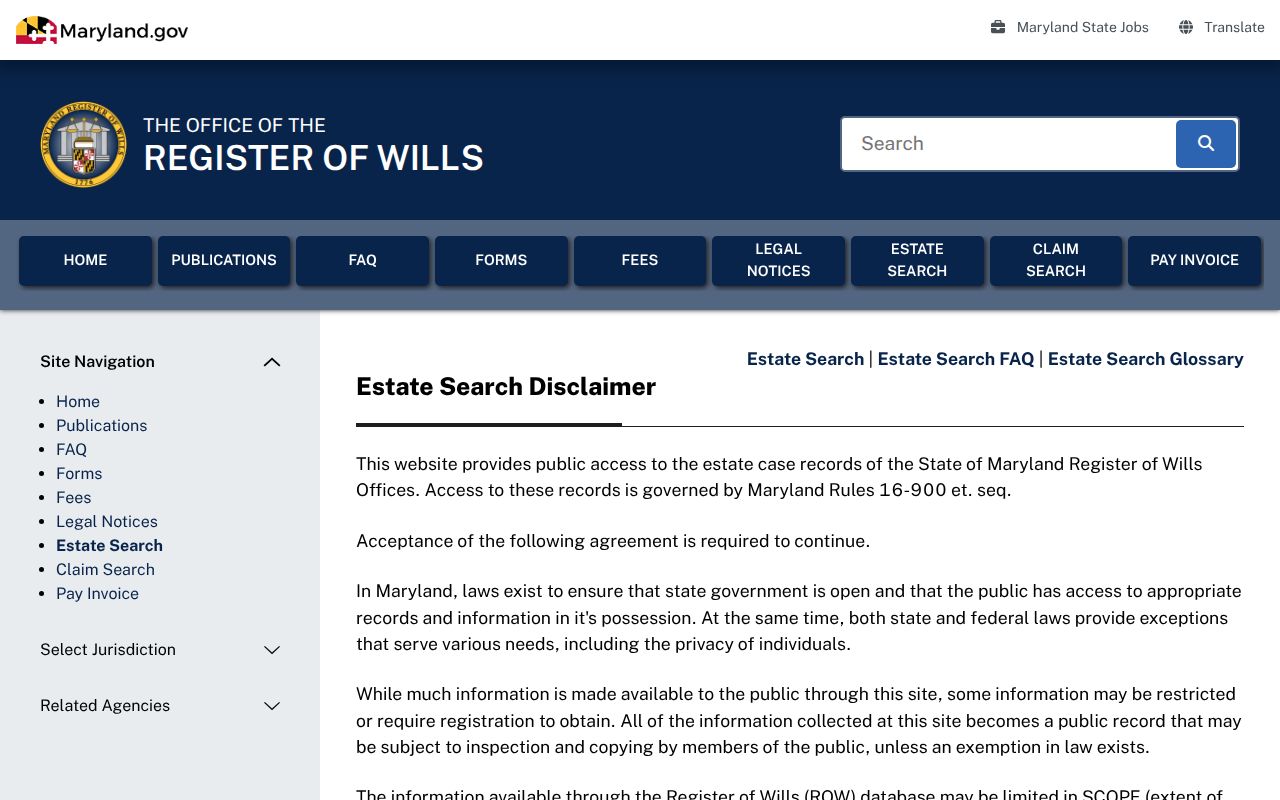
EstateSearch is the practical first stop, but the local Register remains the source for filed documents, certified letters, and archived material.
Maryland Probate Terms Defined
Maryland estate entries use short labels that describe a person's role, the size of the administration, or a specific filing. Reading those terms correctly helps a requester select the right document instead of ordering an entire file.
- Testator
- The person who made the will later presented to the Register after death.
- Personal Representative
- The court-appointed fiduciary authorized to collect assets, address claims, file accounts, and distribute the estate.
- Intestate
- Dying without a valid will, so Maryland intestacy law controls who receives probate property.
- Letters of Administration
- The official proof that the personal representative has authority to act for the estate.
- Guardianship
- A court arrangement for decisions concerning a minor or disabled person; living-adult guardianship is mainly a Circuit Court case.
- Conservatorship
- A general term for court-supervised property management; Maryland records commonly frame this work through guardianship of property.
- Inventory
- The filing that identifies and values probate assets under the personal representative's control.
EstateSearch codes also matter. RE and SE identify regular and small estates. RJ and SJ signal a judicial proceeding, while FP identifies a foreign proceeding involving Maryland property.
How to Search Maryland Probate Records
EstateSearch covers probate estates across all Maryland jurisdictions, although the depth and dates of digitized entries vary. A search can use a decedent's first and last name, estate number, jurisdiction, and date or year refinements. Results may show the estate number, death date, type, status, open or close dates, personal representatives, attorney, docket transactions, and document descriptions. It is an index rather than a promise that every image can be downloaded.
- Identify the decedent's Maryland domicile or the jurisdiction where the estate was opened. Property in Maryland can also support a foreign proceeding.
- Search EstateSearch by full name, then narrow by jurisdiction and date. Use an estate number when available.
- Read the estate type, status, representatives, and docket descriptions. Note the exact estate number and documents needed.
- Contact the local Register by phone, mail, or in person. Ask for a plain, certified, or exemplified copy and authorize a cost cap.
- If a document is restricted or absent online, ask whether party status, proof of interest, a courthouse inspection, or a court order is required.
Older paper, a deposited will, or an unscanned image can still exist when remote search returns little. “Not online” is not the same as “no record.” Ask the Register whether the material is paper, archived, restricted, or held under a different estate number.
Maryland Orphans' Court Locations
Probate begins with the Register of Wills for the Maryland jurisdiction tied to the decedent or estate. A statewide search does not transfer custody of the file to a central office. The local Register controls inspection, copy fulfillment, certification, archived retrieval, accepted payment, and access procedures. This remains true when Harford or Montgomery Circuit Court judges exercise the Orphans' Court role.
Find the local Register: Browse all 24 Maryland jurisdictions to reach the right county or Baltimore City probate office.
Give the office the estate number, decedent's name, and exact filing title or date. A focused request for a will, inventory, account, claim, or Letters costs less and is faster than asking for every paper.
Maryland Probate Filing Fees
Maryland's current Register of Wills fee schedule uses gross probate estate value for estates opened on or after October 1, 2022.
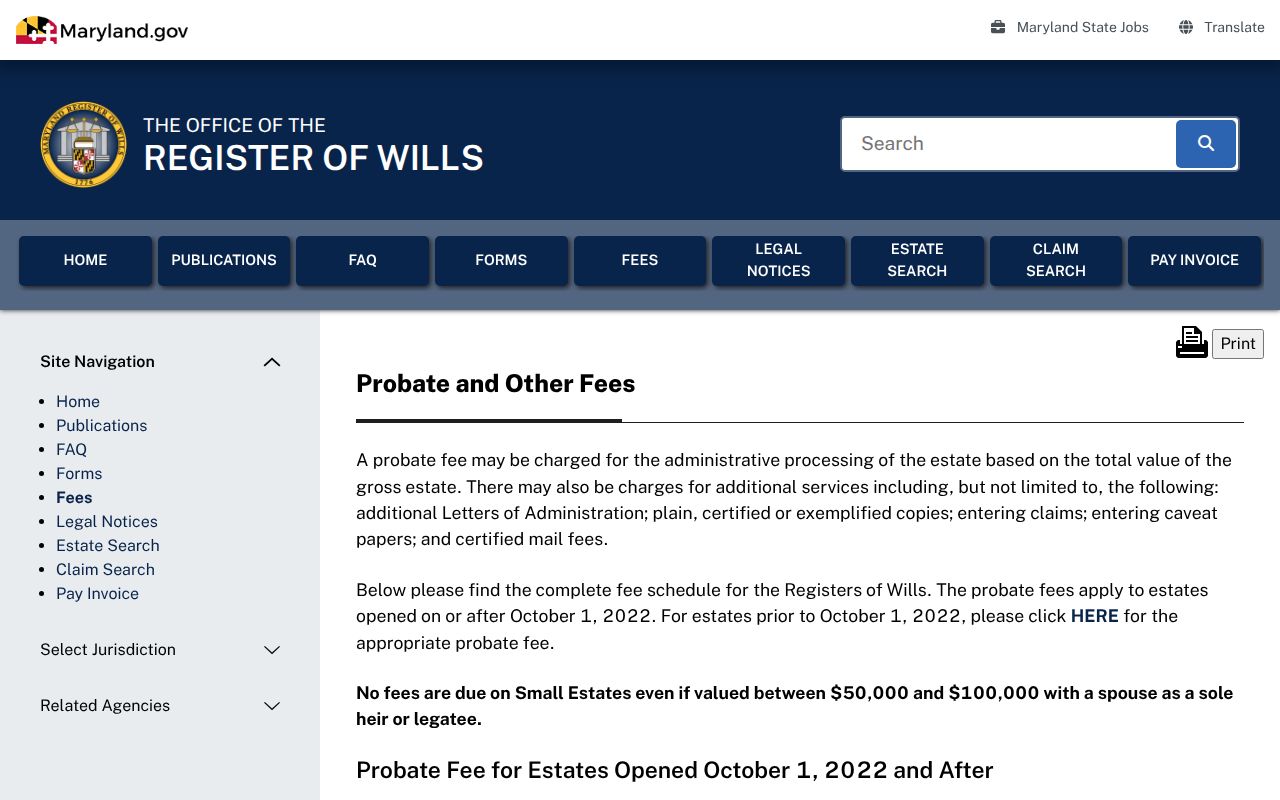
The schedule separates the probate fee from copy, certification, hearing, claim, and contested-paper charges, so the final cost can exceed the value-band fee.
| Gross Probate Estate | Probate Fee |
|---|---|
| $0 to under $50,000 | $0 |
| $50,000 to under $100,000 | $100 |
| $100,000 to under $500,000 | $200 |
| $500,000 to under $1 million | $1,000 |
| $1 million to under $2.5 million | $2,000 |
| $2.5 million to under $5 million | $5,000 |
| $5 million to under $7.5 million | $7,500 |
| $7.5 million to under $10 million | $10,000 |
| $10 million or more | $10,000 plus 0.02% above $10 million |
A qualifying small estate has no probate fee, including an estate from $50,000 through $100,000 when the surviving spouse is the sole heir or legatee. Other researched charges include $0.50 per copy page, $2 added for certification, $6 added for exemplification, $1 for Letters, $3 for a claim, $5 for will safekeeping, $20 for a caveat or controversial paper plus possible court fees, and $25 for a hearing copy. Publication, bond, appraisal, mailing, tax, and legal costs remain separate.
What Maryland Probate Records Show
A Maryland estate file can include the original will and codicils, death evidence, petition for administration, list of interested persons, bond papers, appointment order, Letters of Administration, notice to creditors, inventory, Information Report, claims, tax entries, accounts, receipts, distribution papers, and closing entries. A caveat or dispute may add motions, exceptions, hearing records, and Orphans' Court orders. Each paper answers a different question. Letters prove present authority, while an inventory reports probate assets and an account tracks receipts, payments, and distributions.
Estate status does not prove that all property passed through probate. Joint property, beneficiary-designated accounts, and some trust assets may pass outside the estate, although an Information Report can address nonprobate interests for inheritance-tax purposes. Likewise, a named personal representative is the estate fiduciary, not an agent for every heir. When legal proof matters, order the exact certified document rather than relying on an index screen.
An unrelated source image was assigned to this probate page by the project manifest: the source concerns Maryland parole-supervision fee debt relief.

That policy is not a probate fee rule; Maryland estate costs must be verified against the Register of Wills schedule shown above.
Restricted Maryland Probate Records
A will deposited for safekeeping while the testator lives is confidential. After death, the proper requester supplies proof and follows the Register's process. A sealed order can also limit access. Medical reports, protected identifiers, and sensitive guardianship material may be restricted or redacted even when the public docket remains visible. Ask whether the whole case, one document, or only certain data is closed. Authorized heirs, personal representatives, parties, or counsel should state their relationship and provide the proof the custodian requests.
Maryland judicial-record access is governed by Rules 16-901 through 16-914. A Public Information Act request does not override a judicial seal. If access is refused, request the specific rule, statute, order, or retention reason, then ask about segregable public portions, party access, or the correct motion process. Avoid sending full Social Security, medical, or account information in an ordinary public request.
The manifest also assigns an image from Maryland Criminal Procedure §10-221 on CJIS records.
That statute governs criminal-history dissemination, not access to an estate file; probate restrictions come from the applicable judicial rules, statutes, and court orders.
Find Maryland Probate Records Locally
Search EstateSearch first. Then use its jurisdiction and estate number to contact the local Register. The directory of all 24 Maryland jurisdictions reaches each county and Baltimore City court-record site. Call before visiting for an old or archived file. For mail, provide the decedent, estate number, exact document, copy type, number of copies, return address, preferred format, and maximum approved cost. Confirm the payee and payment method because a statewide index does not create one statewide copy counter.
If the index fails, retry spelling and dates, ask the Register to search by name, inspect at the office, or send a narrow written judicial-record request. For a restricted item, explain lawful status and follow the court's access process. These steps preserve the key Maryland split: EstateSearch finds an estate, while the local Register owns the papers and certification.