
Maryland Court System Overview
Maryland's principal levels are the Supreme Court of Maryland, Appellate Court of Maryland, Circuit Courts, District Court of Maryland, and specialized Orphans' Courts. The Supreme Court is the single court of last resort for civil and criminal matters. The Appellate Court is one statewide intermediate court, not seven separate courts. Circuit and District Courts divide trial jurisdiction. Orphans' Courts work with local Registers of Wills on estates. Maryland has no ordinary municipal, county, or justice-of-the-peace court layer handling routine citations.
The Judiciary's official four-level description shows how jurisdiction changes from trial through appeal.
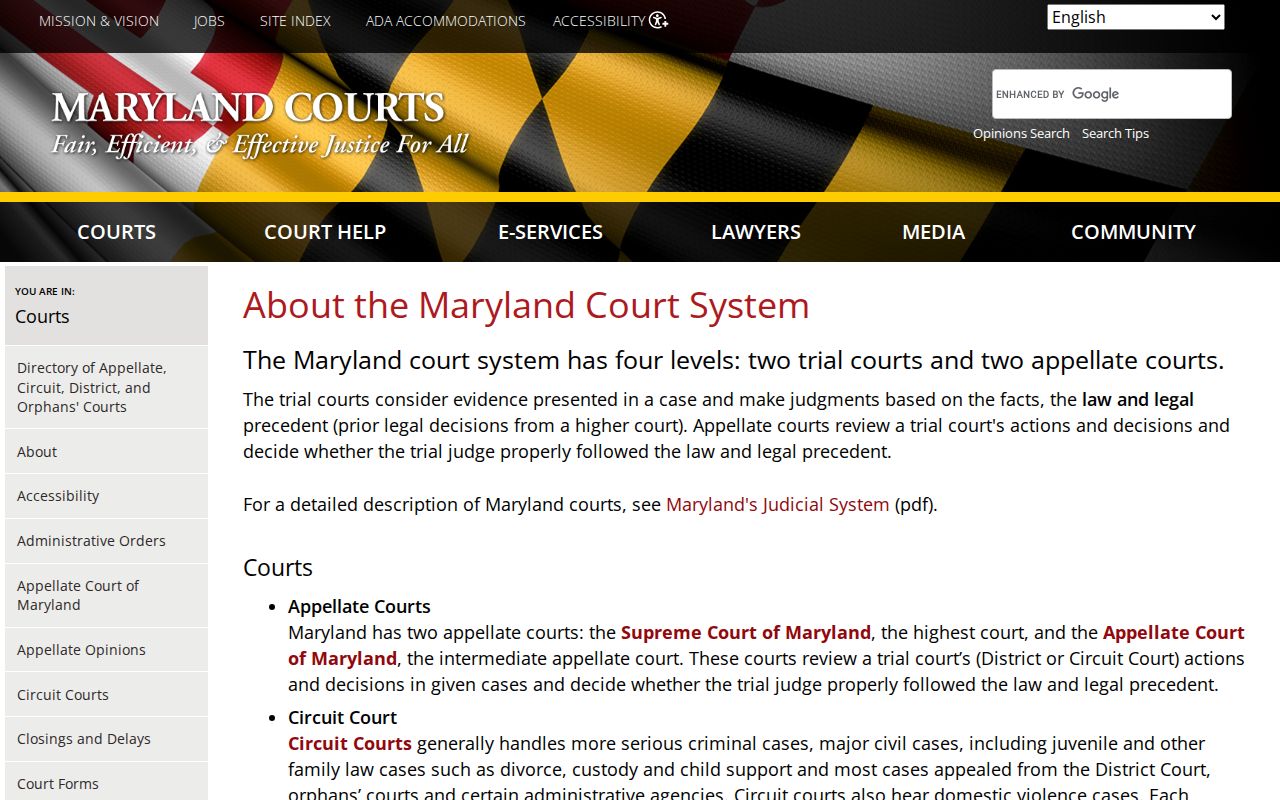
The chart helps explain why one person may have related entries at both trial levels when a felony begins in District Court and later proceeds in Circuit Court.
Appeals path: District Court or Orphans' Court › Circuit Court or Appellate Court, depending on the appeal › Supreme Court of Maryland › U.S. Supreme Court only on a qualifying federal issue
| Court Level | Court Name | Jurisdiction / Case Types | Number in Maryland |
|---|---|---|---|
| Court of Last Resort | Supreme Court of Maryland | Selected appeals, certified questions, discipline, disability matters, and rulemaking | 1 court, 7 justices |
| Intermediate Appellate | Appellate Court of Maryland | Most final Circuit Court appeals, specified leave applications, and Orphans' Court appeals | 1 court, 15 judges |
| General Trial Court | Circuit Court | Felonies, jury trials, civil claims over $30,000, family, juvenile, and lower-court appeals | 24 local courts in 8 circuits |
| Limited Trial Court | District Court of Maryland | Traffic, rent, small and limited civil, misdemeanors, specified felonies, and protective orders | 1 statewide court, 34 locations in 12 districts |
| Specialized Probate | Orphans' Court | Disputed estates, accounts, appointments, and limited probate functions | 24 jurisdictional tribunals |
Maryland Supreme Court Records
The Supreme Court of Maryland has seven justices, one selected from each appellate circuit. It reviews cases accepted through certiorari, certain direct appeals, certified questions, attorney discipline, judicial disability matters, and court rules. Maryland does not divide final civil and criminal review between two high courts. Published holdings bind lower Maryland courts, while a federal constitutional issue may support later review by the U.S. Supreme Court.
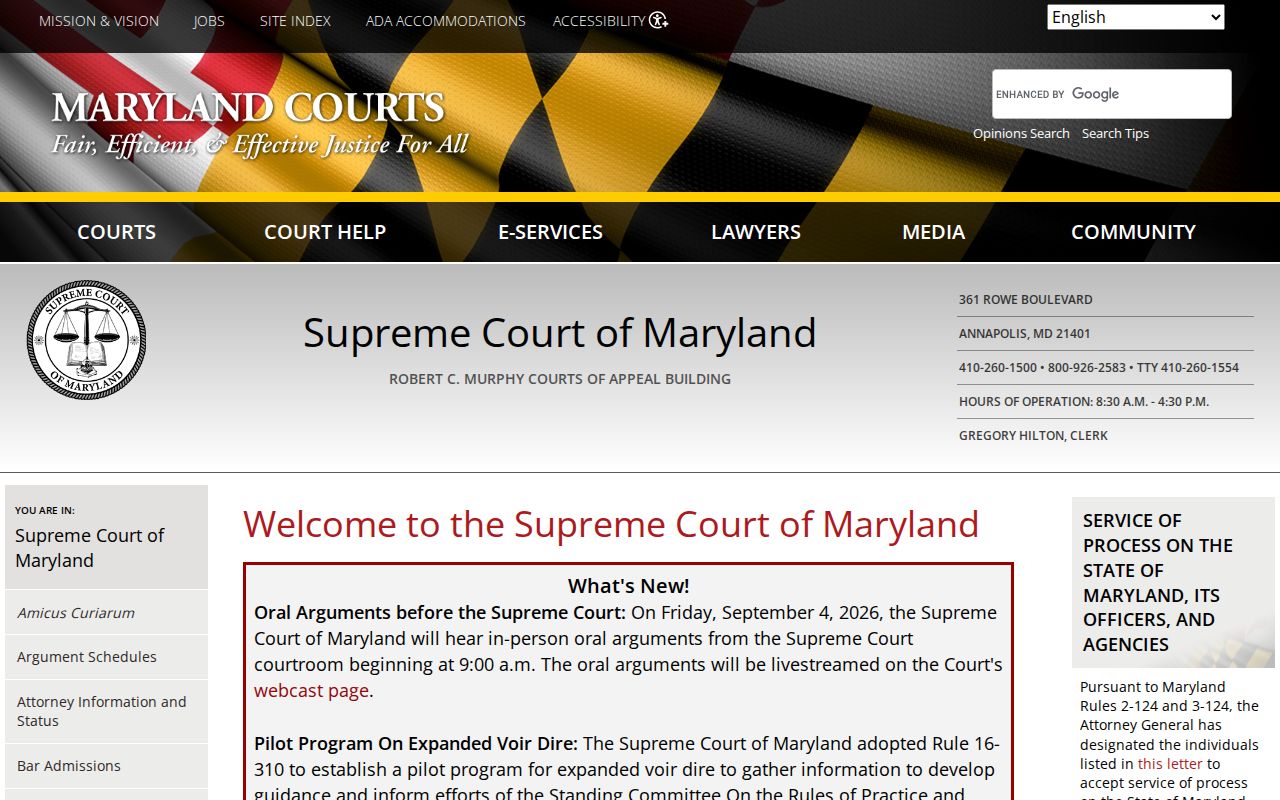
The official court page supplies opinions, calendars, filings, and institutional information for the current high court.
Older sources can call it the Court of Appeals. Voters approved the new name in 2022, effective December 14, 2022. The rename did not create a new institutional line, so researchers should search both names when working with older citations, forms, buildings, or archived records.
Maryland Appellate Court Records
The Appellate Court of Maryland has 15 judges and usually decides cases in panels of three. It hears most appeals from final Circuit Court judgments, specified applications for leave to appeal, and appeals from Orphans' Courts. A party may then petition the Supreme Court for discretionary review. The seven appellate circuits are geographic selection areas for appellate judges. They are not seven independent intermediate courts or seven separate databases.
| Appellate Circuit | Geographic Role | Intermediate Court |
|---|---|---|
| First through Seventh | Selection and representation areas for appellate judges | One statewide Appellate Court of Maryland |
| Panels | Cases are ordinarily heard by three judges | Judgments may face Supreme Court certiorari review |
Maryland Circuit Court Records
Circuit Courts are Maryland's general-jurisdiction trial courts. One operates in every county and Baltimore City, grouped into eight judicial circuits. They hear felonies and serious criminal matters, jury trials, civil claims above $30,000, concurrent claims from $5,000 through $30,000, divorce, custody, support, juvenile and adoption cases, guardianship, and major equity disputes. They also review District Court, Orphans' Court, and agency decisions through the appeal route that applies to the case.
The official Circuit Court directory links the courts and local clerk offices.
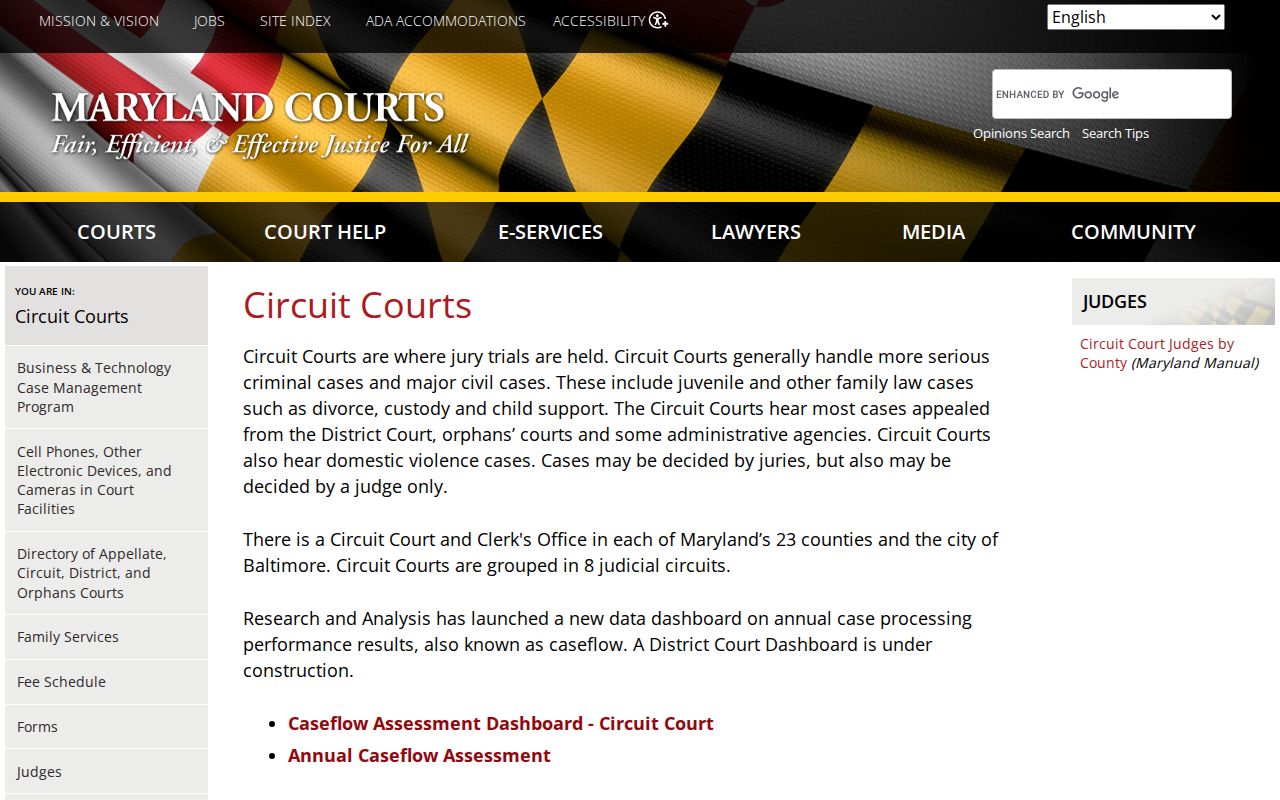
Those elected clerks hold the complete local case file even when statewide Case Search displays a public summary.
Venue and jurisdiction decide where a case starts. A change of venue moves the trial location and creates transfer entries. A recusal changes the judge but not the court. Maryland problem-solving programs, family services, and the Business and Technology Case Management Program operate within existing Circuit or District Courts rather than forming a fifth court level.
Maryland Trial Court Comparison
Maryland splits original trial work primarily between Circuit and District Courts, with Orphans' Court handling probate disputes. The dollar thresholds and jury right are practical routing clues, but filing law and case type still control.
| Circuit Court | District Court | Orphans' Court | |
|---|---|---|---|
| Civil Scope | Claims above $30,000; concurrent $5,000 to $30,000 | Exclusive through $5,000; concurrent through $30,000 | Estate disputes, not general civil claims |
| Criminal Scope | Felonies and jury-demand matters | Misdemeanors, specified felonies, preliminary proceedings | None |
| Family Cases | Divorce, custody, support, juvenile, adoption | Peace and protective orders | Limited guardianship functions |
| Jury | Available where law permits | No jury trials | No ordinary jury trial role |
| Appeal | Usually Appellate Court | Circuit Court | Circuit or Appellate route under governing law |
How Maryland Appeals Work
A clerk opens the case, assigns a number, issues process, and records motions, hearings, orders, judgments, costs, and appeal notices. Appellate courts review claimed legal error rather than retrying witnesses. District Court small claims generally receive a new Circuit Court trial, called de novo review. Regular civil District appeals over $5,000 are generally reviewed on the existing record. Circuit appeals usually proceed to the Appellate Court, with Supreme Court review mainly discretionary.
Criminal case flow: Charging document and District Court initial proceedings › indictment or information where applicable › Circuit Court arraignment and pretrial › plea or trial › sentence › Appellate Court › Supreme Court certiorari petition
Civil case flow: Complaint › service and answer › motions and discovery › settlement process or trial › judgment › Appellate Court when filed in Circuit Court › Supreme Court certiorari petition
Small-claim flow: District Court complaint › simplified hearing without discovery › judgment › generally de novo appeal in Circuit Court
Maryland Court History and Programs
Maryland's modern court structure grew through constitutional and statutory change. The intermediate court began in 1966. The District Court opened on July 5, 1971 and replaced a patchwork of justices of the peace, magistrates, and local people's or municipal courts with one fully state-funded court of record. That history explains why modern traffic, rent, small-claim, and misdemeanor cases use District Court even when hearings take place in local buildings.
Case Search launched in 2006, and Maryland Electronic Courts later expanded electronic filing and case management. The March 2026 integrated Case Search & Record Portal combined public search and authenticated record access without widening what anonymous users may see. Older paper, courthouse kiosk documents, recordings, and certified copies still require the filing clerk.
Special dockets for drug treatment, mental health, veterans, DUI, family recovery, and truancy remain programs within the established courts. Family divisions, mediation, custody evaluation, and complex business case management do not create separate custodians. Restricted juvenile, adoption, medical, and financial documents remain protected even if a public case shell exists.
Maryland District and Orphans' Courts
The District Court of Maryland is one statewide court with 34 locations in 12 administrative districts. It has no juries. Its work includes traffic and boating violations, landlord-tenant cases, replevin, small claims, limited civil cases, misdemeanors, specified felonies, preliminary hearings, and peace or protective orders. A city police ticket ordinarily goes here because Maryland has no parallel municipal court layer for routine citations.
Orphans' Courts specialize in decedent-estate supervision and work with a Register of Wills in each jurisdiction. Harford and Montgomery Circuit judges perform the Orphans' Court role, but their Registers still maintain the administrative probate records. The historic name does not mean these courts deal only with children.
Maryland and Federal Courts
Maryland forms one federal judicial district. The U.S. District Court for the District of Maryland hears federal criminal prosecutions, federal-question and diversity cases, civil-rights suits, and other Article III matters.
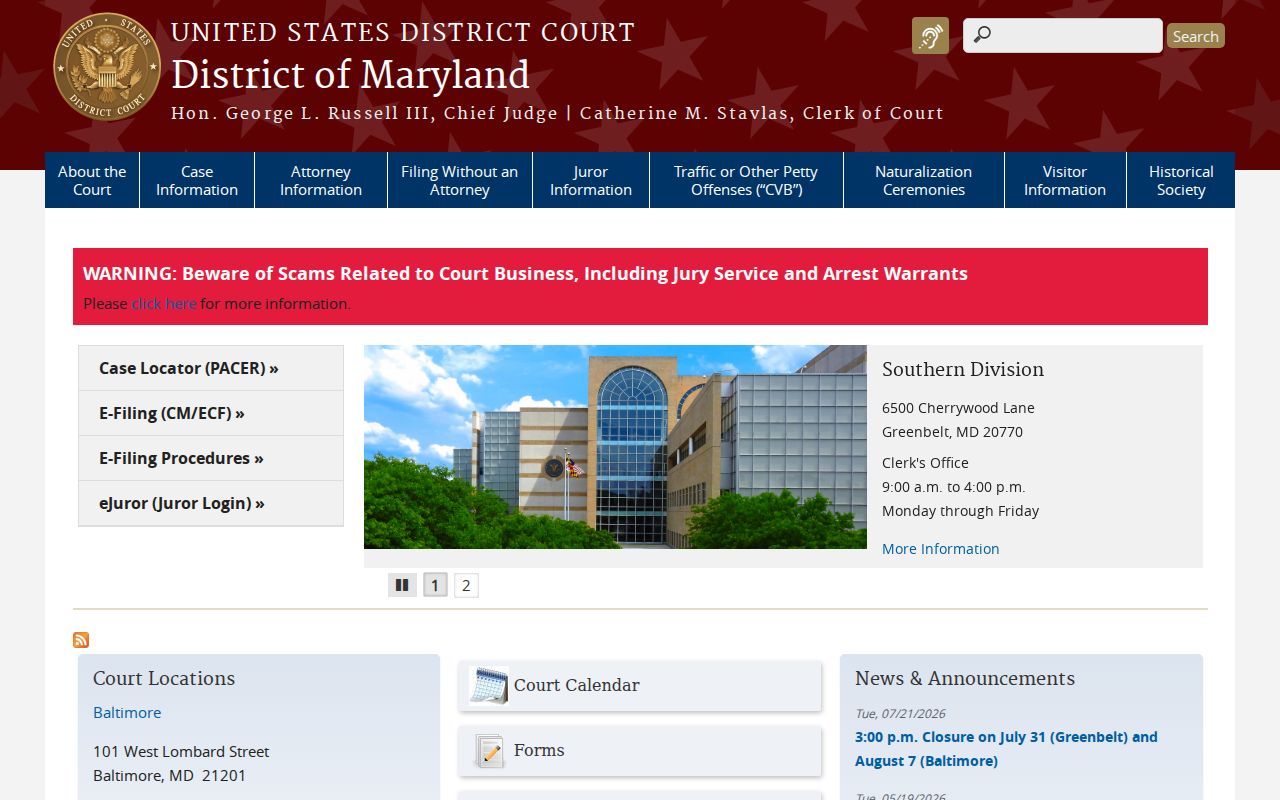
Federal cases do not appear in Maryland Case Search. Their authoritative dockets and filed documents use PACER and the federal clerk.
The U.S. Bankruptcy Court for the District of Maryland handles bankruptcy cases and adversary proceedings.
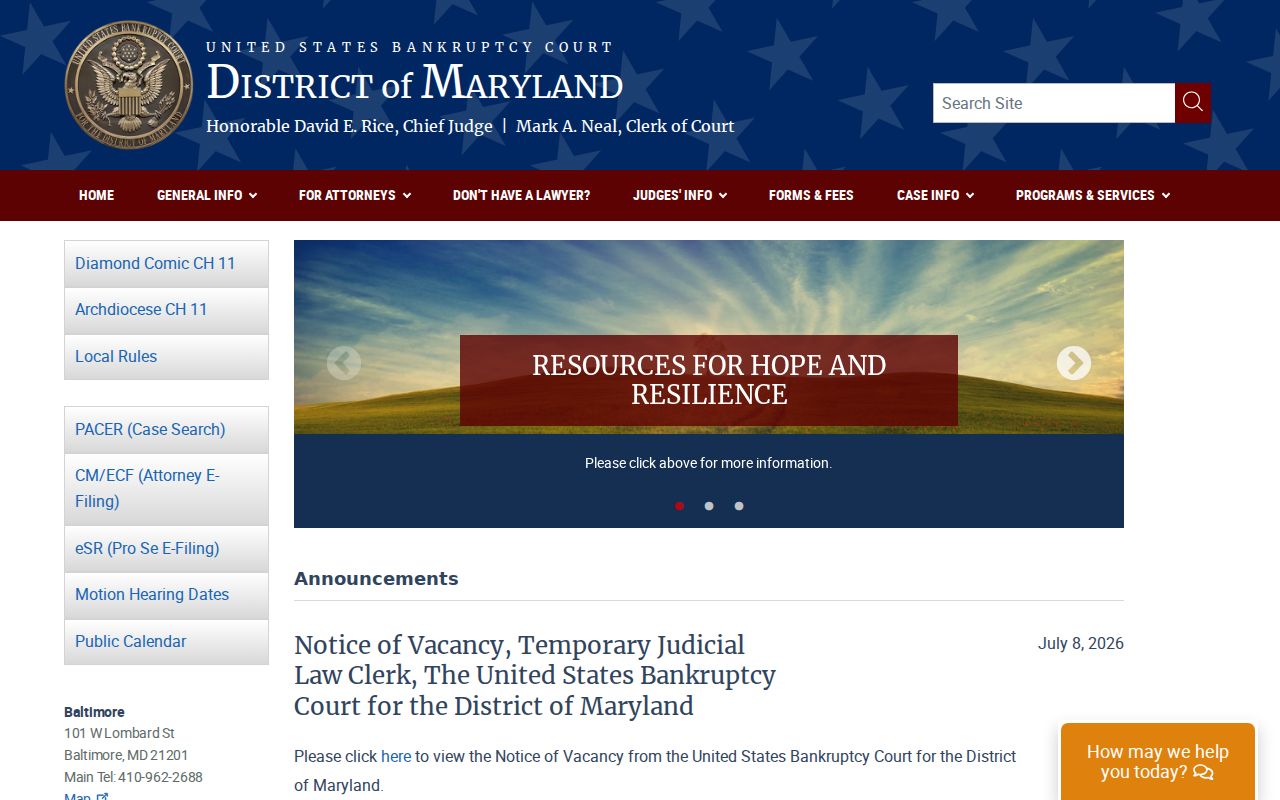
Bankruptcy dockets are separate from ordinary federal District Court civil dockets even though both operate within the federal system.
Federal appeals from Maryland go to the U.S. Court of Appeals for the Fourth Circuit.
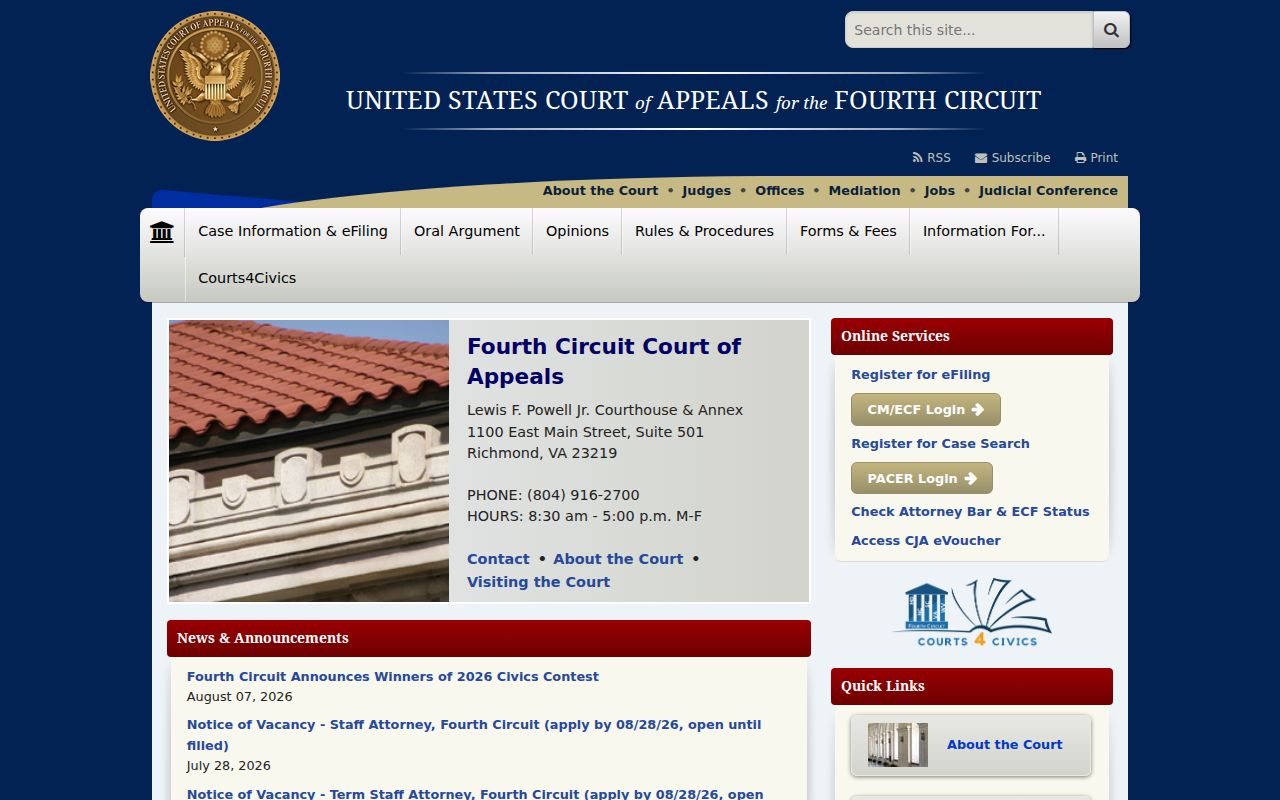
The Fourth Circuit also covers Virginia, West Virginia, North Carolina, and South Carolina, with possible later U.S. Supreme Court review.
For a state trial file, use the directory of all 24 Maryland jurisdictions and contact the Circuit clerk, District Court location, or Register of Wills shown for the filing location. Search statewide first, save the case number and court, then request the complete file or certified copy locally. For a federal file, use PACER or the proper federal clerk instead.